Human Carbonic Anhydrase VB Has cross-reactivity in ELISA with Human CA2 Human CA3 Human CA5A No cross-reactivity in ELISA with Human CA8 Human CA4
Immunogen
Recombinant Human Carbonic Anhydrase VB / CA5B protein (Catalog#12285-H08E)
Preparation
This antibody was obtained from a rabbit immunized with purified, recombinant Human Carbonic Anhydrase VB / CA5B (rh Carbonic Anhydrase VB / CA5B; Catalog#12285-H08E; Q9Y2D0; Cys34-Pro317).
Source
Monoclonal Rabbit IgG Clone #008
Purification
Protein A
Formulation
0.2 μm filtered solution in PBS
Conjugate
Unconjugated
Form
Liquid
Shipping
This antibody is shipped as liquid solution at ambient temperature. Upon receipt, store it immediately at the temperature recommended below.
Storage
This antibody can be stored at 2℃-8℃ for one month without detectable loss of activity. Antibody products are stable for twelve months from date of receipt when stored at -20℃ to -80℃. Preservative-Free. Avoid repeated freeze-thaw cycles.
Synonyms: Anti-CA-VB Antibody; Anti-CAVB Antibody
Image / Experimental Information
Image 1 Description
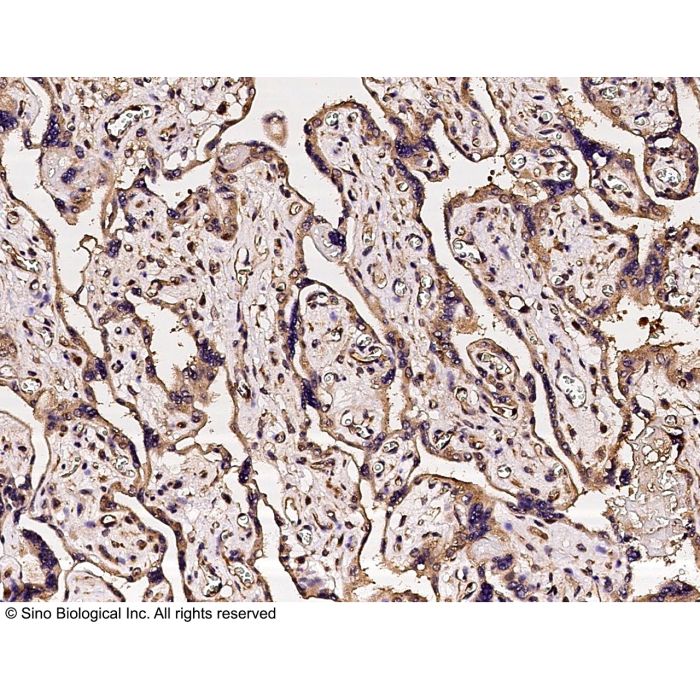
Immunochemical staining of human CA5B in human placenta with rabbit monoclonal antibody (1:100, formalin-fixed paraffin embedded sections).
Image 1 Alt Text
Human Carbonic Anhydrase VB Immunohistochemistry(IHC) 4620
Carbonic anhydrase 5B, also known as carbonate dehydratase VB, carbonic anhydrase VB, CA-VB and CA5B, is amember of the alpha-carbonic anhydrase family. The strongest expression of CA5B / CA-VB is in heart, pancreas, kidney, placenta, lung, and skeletal muscle. It is not expressed in liver. Carbonic anhydrases (CAs) are a large family of zinc metalloenzymes first discovered in 1933 that catalyze the reversible hydration of carbon dioxide. CAs participate in a variety of biological processes, including respiration, calcification, acid-base balance, bone resorption, and the formation of aqueous humor, cerebrospinal fluid, saliva, and gastric acid. CAs show extensive diversity in tissue distribution and in their subcellular localization. CA5B / CA-VB is localized in the mitochondria and shows the highest sequence similarity to the other mitochondrial CA5A / CA-VA. CA5B / CA-VB has a wider tissue distribution than CA5A / CA-VA, which is restricted to the liver. The differences in tissue distribution suggest that the two mitochondrial carbonic anhydrases evolved to assume different physiologic roles. CA5A / CA-VA is activated by histamine, L-adrenaline, L- and D-histidine, and L- and D-phenylalanine. It is inhibited by coumarins, sulfonamide derivatives such as acetazolamide and Foscarnet (phosphonoformate trisodium salt). CA5B / CA-VB is inhibited by coumarins, sulfonamide derivatives such as acetazolamide (AZA), saccharin and Foscarnet (phosphonoformate trisodium salt).
References
Fujikawa-Adachi K, et al.,1999, J Biol Chem. 274 (30): 21228-33.
Liao, S.Y. et al., 2003, J. Med. Genet. 40:257 - 262.
Temperini C.et al., 2006, Chemistry 12: 7057-66.
Temperini C.et al., 2006, J. Med. Chem. 49: 3019-27.
Supuran, C. T. et al., 2008, Curr Pharm Des. 14 (7): 601-602.
Elleuche, S. et al., 2009, Curr Genet. 55 (2): 211-222.
Maresca, A.et al., 2009, J. Am. Chem. Soc. 131:3057-3062.