Recombinant Human Carbonic Anhydrase XII / CA12 protein (Catalog#10617-H08H)
Preparation
This antibody was produced from a hybridoma resulting from the fusion of a mouse myeloma with B cells obtained from a mouse immunized with purified, recombinant Human Carbonic Anhydrase XII / CA12 (rh Carbonic Anhydrase XII / CA12; Catalog#10617-H08H; NP_001209.1; Met1-Gln291) and conjugated with PE under optimum conditions, the unreacted PE was removed.
Source
Monoclonal Mouse IgG1 Clone #07
Purification
Protein A
Formulation
PBS solution containing 0.5% BSA and 0.09% sodium azide
Concentration
2 μl/Test, 0.1 mg/ml
Conjugate
PE
Form
Liquid
Shipping
This antibody is shipped as liquid solution at ambient temperature. Upon receipt, store it immediately at the temperature recommended below.
Storage
This antibody can be stored at 2℃-8℃ for twelve months without detectable loss of activity. Protected from prolonged exposure to light. Do not freeze ! Sodium azide is toxic to cells and should be disposed of properly. Flush with large volumes of water during disposal.
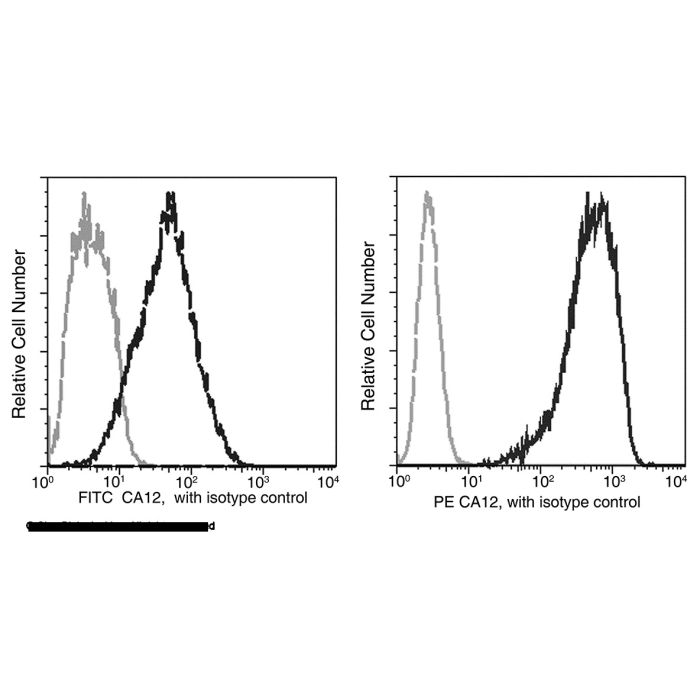
Flow cytometric analysis of Human CA12 expression on MCF-7 cells. Cells were stained with PE-conjugated anti-Human CA12. The fluorescence histograms were derived from gated events with the forward and side light-scatter characteristics of intact cells.
Image 1 Alt Text
Human Carbonic Anhydrase XII Flow Cytometry (FC) 5330
Carbonic anhydrases (CAs) are a large family of zinc metalloenzymes first discovered in 1933 that catalyze the reversible hydration of carbon dioxide. CAs participate in a variety of biological processes, including respiration, calcification, acid-base balance, bone resorption, and the formation of aqueous humor, cerebrospinal fluid, saliva, and gastric acid. CA12, also known as Car12 and carbonic anhydrase XII, is a type I membrane enzyme of an N-terminal extracellular catalytic domain, a membrane-spanning α-helix, and a small intracellular C-terminal domain. It is highly expressed in colon, kidney, prostate, intestine and activated lymphocytes and moderately expressed in pancreas, ovary, and testis. Overexpression of the CA12 is observed in certain human cancers and is used as a tumor marker. rmCA12 corresponds to the extracellular domain and has both carbonic anhydrase activity and esterase activity.
References
Sahin, U. et al., 1996, Proc. Natl. Acad. Sci. U.S.A. 92 (25): 11810–11813.
Ivanov, S.V. et al., 1998, Proc. Natl. Acad. Sci. USA 95:12596 - 12601.
Strausberg, R.L. et al., 2002, Proc. Natl. Acad. Sci. USA 99:16899 - 16903.
Liao, S.Y. et al., 2003, J. Med. Genet. 40:257 - 262.
Supuran, C. T. et al., 2008, Curr Pharm Des. 14 (7): 601-602.
Elleuche, S. et al., 2009, Curr Genet. 55 (2): 211-222.