Human Carbonic Anhydrase XIV/CA14 No cross-reactivity in ELISA with Human CAIX / CA9 Human CA10 / CARPX Human CA12 / CAXII Mouse CA14 / Car14
Immunogen
Recombinant Human CA14 protein (Catalog#10458-H08H)
Preparation
This antibody was obtained from a rabbit immunized with purified, recombinant Human CA14 / Car14 extracellular domain (rh CA14; Catalog#10458-H08H; NP_036245.1; Met 1-Met 290).
Source
Monoclonal Rabbit IgG Clone #004
Purification
Protein A
Formulation
0.2 μm filtered solution in PBS
Conjugate
Unconjugated
Form
Liquid
Shipping
This antibody is shipped as liquid solution at ambient temperature. Upon receipt, store it immediately at the temperature recommended below.
Storage
This antibody can be stored at 2℃-8℃ for one month without detectable loss of activity. Antibody products are stable for twelve months from date of receipt when stored at -20℃ to -80℃. Preservative-Free. Avoid repeated freeze-thaw cycles.
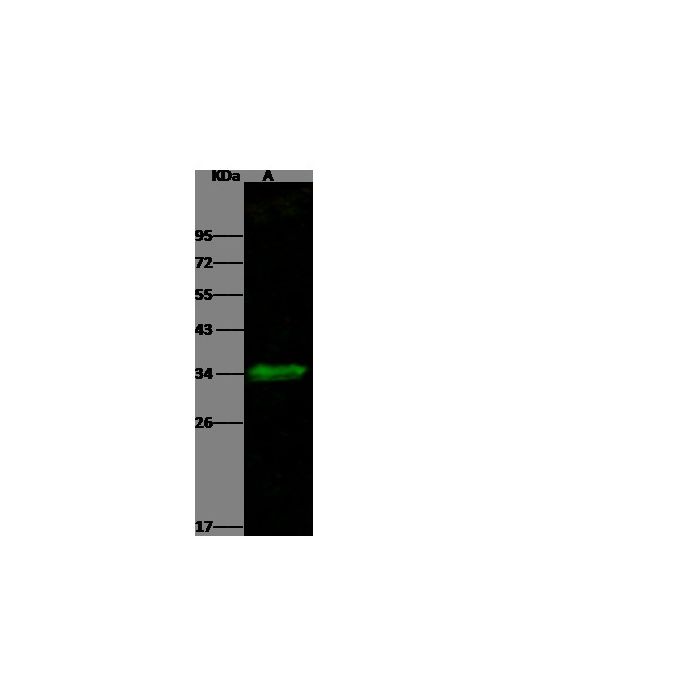
Anti-CA14 rabbit monoclonal antibody at 1:500 dilution Lane A: Jurkat Whole Cell Lysate Lysates/proteins at 30 μg per lane. Secondary Goat Anti-Rabbit IgG H&L (Dylight800) at 1/10000 dilution. Developed using the Odyssey technique. Performed under reducing conditions. Predicted band size:38 kDa Observed band size:34 kDa
Image 1 Alt Text
Human Carbonic Anhydrase XIV Western blot (WB) 16046
The carbonic anhydrases (or carbonate dehydratases) are classified as metalloenzyme for its zinc ion prosthetic group and form a family of enzymes that catalyze the rapid interconversion of carbon dioxide and water to bicarbonate and protons, a reversible reaction that takes part in maintaining acid-base balance in blood and other tissues. The carbonic anhydrasekl (CA) family consists of at least 11 enzymatically active members and a few inactive homologous proteins. CAXIV is a member of CA family that showed an overall similarity of 29–46% to other active CA isozymes. The highest percentage similarity was with a transmembrane CA isoform, CAXII. The CAXIV was found high concentrations in human heart, brain, liver, and skeletal muscle but lower in the colon, small intestine, urinary bladder, and kidney. No CAXIV mRNA was seen in the salivary gland and pancreas. CAXIV is a likely candidate for the extracellular CA postulated to have an important role in modulating excitatory synaptic transmission in brain.
References
Lehtonen J, et al. (2004) Characterization of CA XIII, a Novel Member of the Carbonic Anhydrase Isozyme Family. The Journal of Biological Chemistry. 279: 2719-27.
Lindskog S. (1997) Structure and mechanism of carbonic anhydrase. Pharmacology & Therapeutics. 74(1):1-20.
Parkkila S, et al. (2001) Expression of membrane-associated carbonic anhydrase XIV on neurons and axons in mouse and human brain. PNAS. 98(4): 1918-23.