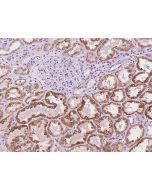
Human Carboxypeptidase E/CPE No cross-reactivity in ELISA with Human Carboxypeptidase-A1 / CPA1 Human Carboxypeptidase-A2 / CPA2 Human Carboxypeptidase-B1 / CPB1
Immunogen
Recombinant Human CPE protein (Catalog#10069-H08H)
Preparation
This antibody was obtained from a rabbit immunized with purified, recombinant Human CPE (rhCPE; Catalog#10069-H08H; NP_001864.1; Met 1-Ser 453).
Source
Monoclonal Rabbit IgG Clone #1
Purification
Protein A
Formulation
0.2 μm filtered solution in PBS
Conjugate
Unconjugated
Form
Liquid
Shipping
This antibody is shipped as liquid solution at ambient temperature. Upon receipt, store it immediately at the temperature recommended below.
Storage
This antibody can be stored at 2℃-8℃ for one month without detectable loss of activity. Antibody products are stable for twelve months from date of receipt when stored at -20℃ to -80℃. Preservative-Free. Avoid repeated freeze-thaw cycles.
Carboxypeptidase E (CPE), also known as Carboxypeptidase H, is a peripheral membrane protein and a zinc metallocarboxypeptidase, and the conversion of proCPE into CPE occurs primarily in secretory vesicles. The active form of CPE cleaves C-terminal amino acid residues of the peptide, and is thus involved in the biosynthesis of peptide hormones and neurotransmitters including insulin, enkephalin, etc. The enzymatic activity is enhanced by millimolar concentrations of Co2+. It has also been proposed that membrane-associated carboxypeptidase E acts as a sorting receptor for targeting regulated secretory proteins which are mostly prohormones and neuropeptides in the trans-Golgi network of the pituitary and in secretory granules into the secretory pathway.Its interaction with glycosphingolipid-cholesterol rafts at the TGN facilitates the targeting. Mutations in this gene are implicated in type II diabetes due to impaired glucose clearance and insulin resistance.
References
Manser, E. et al., 1990, Biochem. J. 267: 517-525.
Cool, D.R. et al., 1997, Cell. 88: 73-83.
Song, L. and Fricker, L. 1995, J. Neurochem. 65: 444-453.
Dhanvantari,S. et al., 2000, J. Biol. Chem. 275: 29887-29893.
Jeffrey, K.D. et al., 2008, Proc. Natl. Acad. Sci. U.S.A. 105: 8452-8457