Recombinant Human Caspase-14 / CASP14 protein (Catalog#11856-H07E)
Preparation
This antibody was obtained from a rabbit immunized with purified, recombinant Human Caspase-14 / CASP14 (rh Caspase-14 / CASP14; Catalog#11856-H07E; NP_036246.1; Ser 2-Gln 242).
Source
Monoclonal Rabbit IgG Clone #145
Purification
Protein A
Formulation
0.2 μm filtered solution in PBS
Conjugate
Unconjugated
Form
Liquid
Shipping
This antibody is shipped as liquid solution at ambient temperature. Upon receipt, store it immediately at the temperature recommended below.
Storage
This antibody can be stored at 2℃-8℃ for one month without detectable loss of activity. Antibody products are stable for twelve months from date of receipt when stored at -20℃ to -80℃. Preservative-Free. Avoid repeated freeze-thaw cycles.
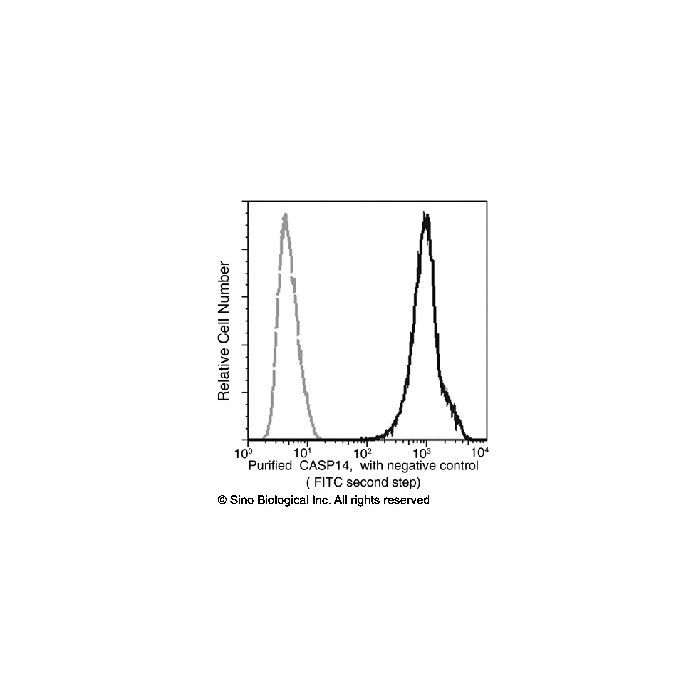
Human CASP14 expression in HeLa cells. The cells were treated according to manufacturer’s manual (BD Pharmingen™ Cat. No. 554714), and stained with Purified Rabbit anti-CASP14 (11856-R145), then a FITC-conjugated second step antibody. The fluorescence histograms were derived from gated events with the forward and side light-scatter characteristics of intact cells.
Caspase 14 is a member of the caspase family. Caspases are a kind of cysteine proteinase consisting of a prodomain plus large and small catalytic subunits, that play a central role in cell apoptosis. Caspase 14 possesses an unusually short prodomain and is highly expressed in embryonic tissues but absent from most of the adult tissues except for the skin, which suggests a role in ontogenesis and skin physiology. Unlike the other short prodomain caspases(caspase-3, caspase-6, and caspase-7), Caspase 14 was not processed by multiple death stimuli including activation of members of the tumor necrosis factor receptor family and expression of proapaptotic members of the bcl-2 family. Caspase 14 has been described to be processed and activated by anti-Fas agonist antibody or TNF-related apoptosis inducing ligand in vivo. The expression and processing of this caspase may take part in keratinocyte terminal differentiation, which is essential for the skin barrier.
Related Pathways
EGFR Signaling Pathway
p53 Pathway
References
Hu SM, et al. (1998) Caspase-14 is a novel developmentally regulated protease. The journal of biological chemistry. 273: 29648-53.
Marc Van De Craen, et al. (1998) Identification of a new caspase homologue: caspase-14. Cell death differ. 5(10): 838-46.