A synthetic peptide corresponding to the N-terminus of the Human CAV3
Preparation
Produced in rabbits immunized with A synthetic peptide corresponding to the N-terminus of the Human CAV3, and purified by antigen affinity chromatography.
Source
Polyclonal Rabbit IgG
Purification
Protein A & Antigen Affinity
Formulation
0.2 μm filtered solution in PBS
Conjugate
Unconjugated
Form
Liquid
Shipping
This antibody is shipped as liquid solution at ambient temperature. Upon receipt, store it immediately at the temperature recommended below.
Storage
This antibody can be stored at 2℃-8℃ for one month without detectable loss of activity. Antibody products are stable for twelve months from date of receipt when stored at -20℃ to -80℃. Preservative-Free. Avoid repeated freeze-thaw cycles.
Caveolinopathies are a heterogeneous family of genetic pathologies arising from alterations of the caveolin-3 gene (CAV3), encoding for the isoform specifically constituting muscle caveolae. Caveolin-3 (CAV3) is a principal structural protein of the caveolae membrane domains, which has been reported to participate in cell signaling as well as the maintenance of cell structure. Mutations in the CAV3 gene encoding caveolin-3 (Cav3), a scaffolding protein integral to caveolae in cardiomyocytes, have been associated with the congenital long-QT syndrome (LQT9). Mutations in caveolin-3 (CAV3) can lead to different clinical phenotypes affecting skeletal or cardiac muscles. Mutations in CAV3 lead to various neuromuscular phenotypes with partial overlap, including limb-girdle muscular dystrophy type 1C (LGMD1C), rippling muscle disease, distal myopathy, and isolated hyperCKemia.
References
Yang RB, et al. (2019) Overexpression of cav3 facilitates bone formation via the wnt signaling pathway in osteoporotic rats. Endocrine 63 (3): 639-650.
Tyan L, et al. (2019) Long qt syndrome caveolin-3 mutations differentially modulate k(v) 4 and ca(v) 1.2 channels to contribute to action potential prolongation. J Physiol 597 (6): 1531-1551.
Stavusis J, et al. (2015) Cav3 gene sequence variations: National genome database and clinics. Acta Neurol Scand 132 (3): 185-190.
Scalco RS, et al. (2016) Cav3 mutations causing exercise intolerance, myalgia and rhabdomyolysis: Expanding the phenotypic spectrum of caveolinopathies. Neuromuscul Disord 26 (8): 504-510.

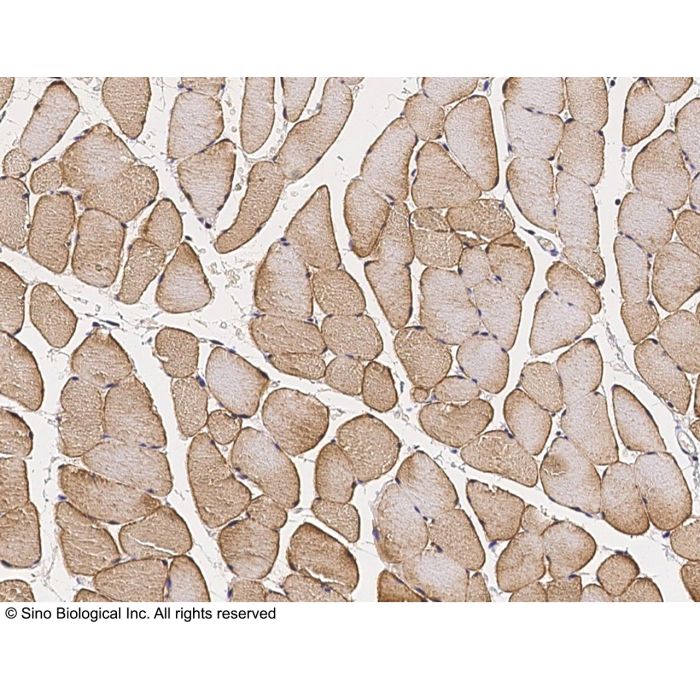


-HB08OC3008-0.5ug-skeletal-muscle-IHC-P.png)
-HB08OC3008-0.5ug-heart-IHC-P.png)
-HB08OC3008-2000-mouse-heart-IHC-P.png)
-HB08OC3008-2000-mouse-skeletal-muscle-IHC-P.png)
-HB08OC3008-2000-rat-heart-IHC-P.png)