A synthetic peptide corresponding to the N-terminus of the Human CCR2/CD192
Preparation
Produced in rabbits immunized with a synthetic peptide corresponding to the N-terminus of the Human CCR2/CD192, and purified by antigen affinity chromatography.
Source
Polyclonal Rabbit IgG
Purification
Protein A & Antigen Affinity
Formulation
0.2 μm filtered solution in PBS
Conjugate
Unconjugated
Form
Liquid
Shipping
This antibody is shipped as liquid solution at ambient temperature. Upon receipt, store it immediately at the temperature recommended below.
Storage
This antibody can be stored at 2℃-8℃ for one month without detectable loss of activity. Antibody products are stable for twelve months from date of receipt when stored at -20℃ to -80℃. Preservative-Free. Avoid repeated freeze-thaw cycles.
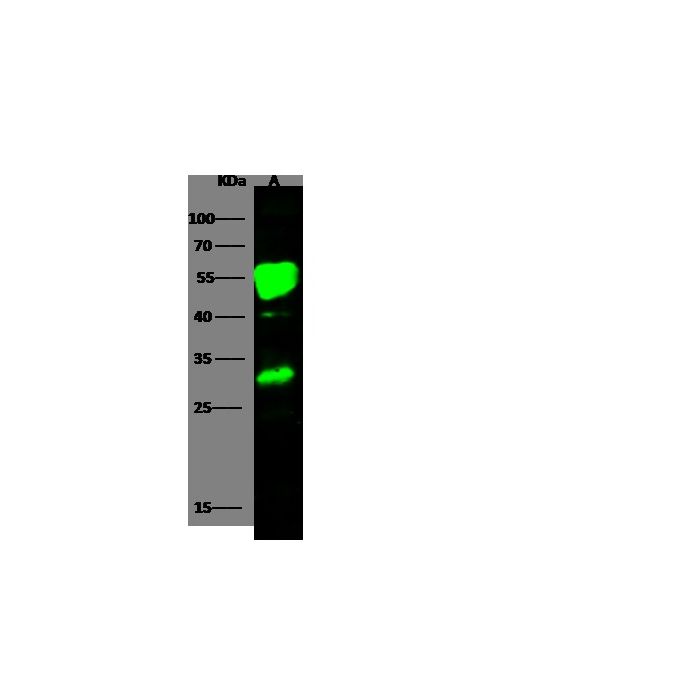
Anti-CD192 rabbit polyclonal antibody at 1:500 dilution. Lane A: A431 Membrane Lysate Lysates/proteins at 30 μg per lane. Secondary Goat Anti- Rabbit IgG H&L (Dylight 800) at 1/10000 dilution. Developed using the Odyssey technique. Performed under reducing conditions. Predicted band size:42 kDa Observed band size:55 kDa (We are unsure as to the identity of these extra bands.)
Anti-CD192 rabbit polyclonal antibody at 1:500 dilution. Lane A: A431 Membrane Lysate Lysates/proteins at 30 μg per lane. Secondary Goat Anti- Rabbit IgG H&L (Dylight 800) at 1/10000 dilution. Developed using the Odyssey technique. Performed under reducing conditions. Predicted band size:42 kDa Observed band size:55 kDa (We are unsure as to the identity of these extra bands.)
The C-C motif chemokine receptor-2 (CCR2) is a G protein-coupled receptor (GPCR), made up of a carboxy-terminus, extracellular amino terminus, and a hydrophobic transmembrane domain consisting of 7 amino acid segments that mediates agonist-dependent calcium mobilization and inhibition of adenylyl cyclase. CCR2 is expressed on monocytes, immature dendritic cells, and T-cell subpopulations, and mediates their migration towards endogenous CCL2. CCR2 is necessary for macrophage-dependent inflammatory responses and the development of atherosclerosis. In mice, CCR2 deficiency reduced macrophage content, increased adiponectin expression, ameliorated hepatic steatosis, and improved systemic glucose homeostasis and insulin sensitivity. Resistance to HIV-1 infection or delayed progression to AIDS may be linked to CCR2 polymorphisms. Furthermore, CCR2 mRNA was highly expressed in prostate cancer (PCa) metastatic tissues compared with benign prostate tissues according to real-time RT-PCR3, suggesting that CCR2 may contribute to PCa development.

-HD09AP1322-WB.png)
-HD09AP1322-1ug-A431-IF.png)