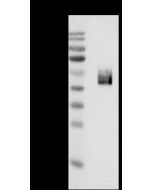
Human CD146/MCAM No cross-reactivity in ELISA and WB with Human CD66a / CEACAM1 Human CD166 / alcama Human CD106 / VCAM1 Human CD226 / DNAM-1 Human BCAM / CD239 Human cell lysate (293 cell line).
Immunogen
Recombinant Human CD146 protein (Catalog#10115-H08H)
Preparation
This antibody was produced from a hybridoma resulting from the fusion of a mouse myeloma with B cells obtained from a mouse immunized with purified, recombinant Human CD146 / MCAM extracellular domain (rh CD146; Catalog#10115-H08H; NP_006491.2; Met 1-Gly 559). The IgG fraction of the cell culture supernatant was purified by Protein A affinity chromatography.
Source
Monoclonal Mouse IgG1 Clone #2E2F4D5
Purification
Protein A
Formulation
0.2 μm filtered solution in PBS
Conjugate
Unconjugated
Form
Liquid
Shipping
This antibody is shipped as liquid solution at ambient temperature. Upon receipt, store it immediately at the temperature recommended below.
Storage
This antibody can be stored at 2℃-8℃ for one month without detectable loss of activity. Antibody products are stable for twelve months from date of receipt when stored at -20℃ to -80℃. Preservative-Free. Avoid repeated freeze-thaw cycles.
The CD146 antigen, also known as melanoma cell adhesion molecule (MCAM) and MUC18, is an integral membrane glycoprotein belonging to the immunoglobulin superfamily. CD146 contains the characteristic immunoglobulin-like domains (V-V-C2-C2-C2), a transmembrane region, and a short cytoplasmic tail. The CD146 expression is detected in endothelial cells in vascular tissue throughout the body and plays a role in cell adhesion, as well as in cohesion of the endothelial monolayer at intercellular junctions in vascular tissue. As a Ca2+-independent cell adhesion molecule involved in heterophilic cell to cell interactions and a surface receptor, CD146 triggers tyrosine phosphorylation of FYN and PTK2 and subsequently induced signal transduction, proteolysis, or immune recognition. This protein is also expressed predominantly on metastatic lesions and advanced primary tumors, and thus has been suggested to play an important role in tumor progression and the development of metastasis in certain human carcinomas.
References
Mills L, et al. (2002) Fully human antibodies to MCAM/MUC18 inhibit tumor growth and metastasis of human melanoma. Cancer Res. 62(17): 5106-14.
Taira E, et al. (2004) Characterization of Gicerin/MUC18/CD146 in the rat nervous system. J Cell Physiol. 198(3): 377-87.
Fritzsche FR, et al. (2008) CD146 protein in prostate cancer: revisited with two different antibodies. Pathology. 40(5): 457-64.
Bidlingmaier S, et al. (2009) Identification of MCAM/CD146 as the target antigen of a human monoclonal antibody that recognizes both epithelioid and sarcomatoid types of mesothelioma. Cancer Res. 69(4): 1570-7.
Boneberg EM, et al. (2009) Soluble CD146 is generated by ectodomain shedding of membrane CD146 in a calcium-induced, matrix metalloprotease-dependent process. Microvasc Res. 78(3): 325-31.