Recombinant Human CD157/BST1 Protein (Catalog#10060-H08H)
Preparation
This antibody was produced from a hybridoma resulting from the fusion of a mouse myeloma with B cells obtained from a mouse immunized with purified, recombinant Human CD157/BST1 (rh CD157/BST1; Catalog#10060-H08H; NP_004325.2; Met1-Lys292) and conjugated with FITC under optimum conditions, the unreacted FITC was removed.
Source
Monoclonal Mouse IgG1 Clone #19
Purification
Protein A
Formulation
PBS solution containing 0.5% BSA and 0.09% sodium azide
Concentration
5 μl/Test, 0.1 mg/ml
Conjugate
FITC
Form
Liquid
Shipping
This antibody is shipped as liquid solution at ambient temperature. Upon receipt, store it immediately at the temperature recommended below.
Storage
This antibody can be stored at 2℃-8℃ for twelve months without detectable loss of activity. Protected from prolonged exposure to light. Do not freeze ! Sodium azide is toxic to cells and should be disposed of properly. Flush with large volumes of water during disposal.
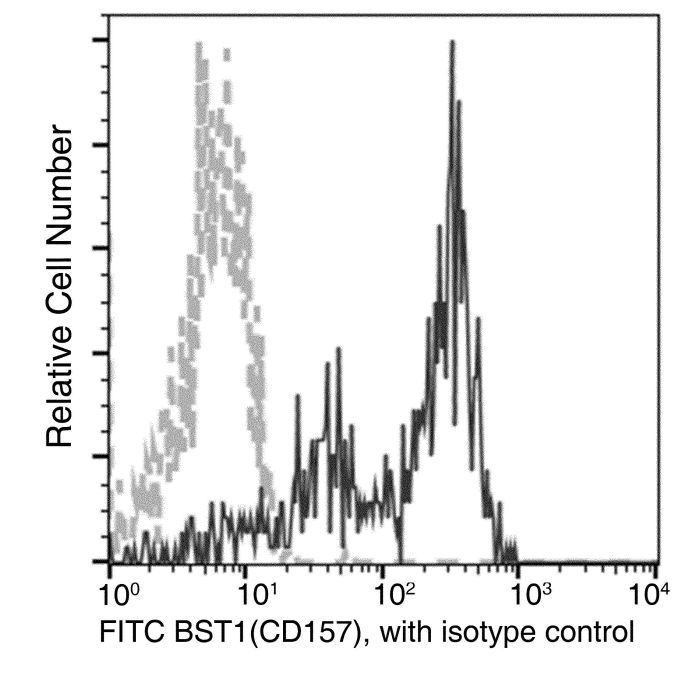
Flow cytometric analysis of Human BST1(CD157) expression on human whole blood monocytes. Cells were stained with FITC-conjugated anti-Human BST1(CD157). The fluorescence histograms were derived from gated events with the forward and side light-scatter characteristics of viable monocytes.
The cluster of differentiation (CD) system is commonly used as cell markers in immunophenotyping. Different kinds of cells in the immune system can be identified through the surface CD molecules associating with the immune function of the cell. There are more than 320 CD unique clusters and subclusters have been identified. Some of the CD molecules serve as receptors or ligands important to the cell through initiating a signal cascade which then alter the behavior of the cell. Some CD proteins do not take part in cell signal process but have other functions such as cell adhesion. CD157, also known as ADP-ribosyl cyclase 2, is an ectoenzyme sharing several characteristics with ADP-ribosyl cyclase CD38. CD157 was originally identified as a bone marrow stromal cell molecule (BST-1) with a glycosylphosphatidylinositol (GPI) anchor to bind to the cell surface. CD157 is prevalently expressed by cells of the myeloid lineage. CD157 could act as a receptor with signal transduction capability. Further, it regulates calcium homeostasis and promotes polarization in neutrophils and mediates superoxide (O ) production in the human U937 myeloid line.
References
Zola H, et al. (2007) CD molecules 2006-human cell differentiation molecules. J Immunol Methods. 318 (1-2): 1-5.
Ho IC, et al. (2009) GATA3 and the T-cell lineage: essential functions before and after T-helper-2-cell differentiation. Nat Rev Immunol. 9 (2): 125-35.
Matesanz-Isabel J, et al. (2011) New B-cell CD molecules. Immunology Letters.134 (2): 104-12.
Malavasi F, et al. (2006) CD38 and CD157 as Receptors of the Immune System: A Bridge Between Innate and Adaptive Immunity. Molecular Medicine. 12 (11-12): 334-41.
Ortolan E, et al. (2002) CD157, the janus of CD38 but with a unique personality. Cell Biochemistry and Function. 20 (4): 309-22.

-MM19-FITC-Monocytes.png)