Recombinant Human CD160 / NK1 / BY55 Protein (Catalog#12191-H08H)
Preparation
This antibody was produced from a hybridoma resulting from the fusion of a mouse myeloma with B cells obtained from a mouse immunized with purified, recombinant Human CD160 / NK1 / BY55 (rh CD160 / NK1 / BY55; Catalog#12191-H08H; NP_008984.1; Met1-Leu158) and conjugated with FITC under optimum conditions, the unreacted FITC was removed.
Source
Monoclonal Mouse IgG2b Clone #09
Purification
Protein A
Formulation
PBS solution containing 0.5% BSA and 0.09% sodium azide
Concentration
5 μl/Test, 0.1 mg/ml
Conjugate
FITC
Form
Liquid
Shipping
This antibody is shipped as liquid solution at ambient temperature. Upon receipt, store it immediately at the temperature recommended below.
Storage
This antibody can be stored at 2℃-8℃ for twelve months without detectable loss of activity. Protected from prolonged exposure to light. Do not freeze ! Sodium azide is toxic to cells and should be disposed of properly. Flush with large volumes of water during disposal.
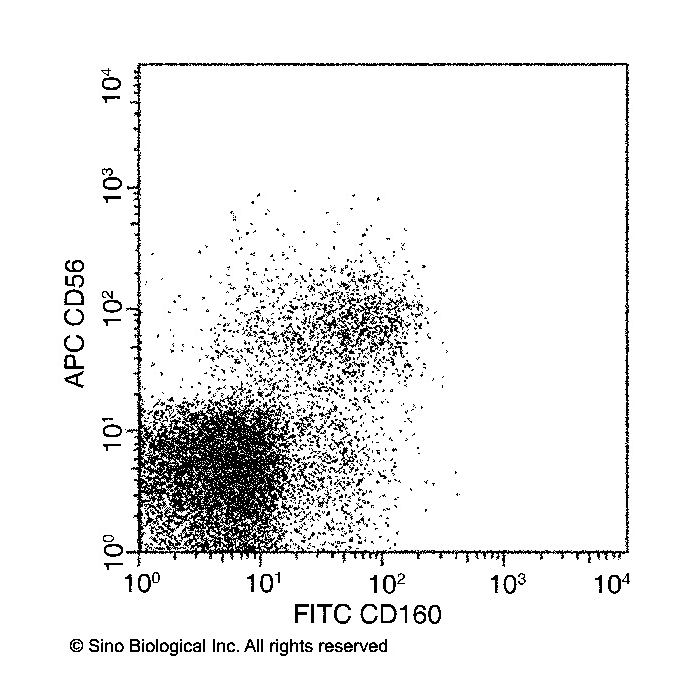
Flow cytometric analysis of Human CD160 expression on human whole blood lymphocytes. Cells were stained with FITC-conjugated anti-Human CD160 and APC-conjugated anti-Human CD56. The dot plots were derived from gated events with the forward and side light-scatter characteristics of viable lymphocytes.
CD16 antigen, also known as Natural killer cell receptor BY55 and CD16, is a cell membrane protein which contains one Ig-like V-type (immunoglobulin-like) domain. CD16 is a GPI-anchored lymphocyte surface receptor in which expression is mostly restricted to the highly cytotoxic CD56(dim)CD16(+) peripheral blood NK subset. CD16 is a receptor showing broad specificity for both classical and non-classical MHC class I molecules. CD16 is expressed in spleen, peripheral blood, and small intestine. Expression of CD16 is restricted to functional NK and T cytotoxic lymphocytes. CD16 acts as a co-activator receptor for CD3-induced proliferation of CD4+ CD16+ T cells isolated from inflammatory skin lesions. Unique CD4+ CD16+ lymphocyte subset may play a role in the pathogenesis of skin inflammation. Activated NK lymphocytes release a soluble form of CD16 that functionally impairs the MHC-I-specific cytotoxic CD8(+) T lymphocyte responsiveness.
Research Areas
Cancer Drug Targets
Tags
Cancer Immunotherapy
Co-inhibitory Immune Checkpoint Targets
Immune Checkpoint
Immune Checkpoint Detection: Antibodies
Immune Checkpoint Detection: ELISA Antibodies
Immune Checkpoint Detection: FCM Antibodies
Immune Checkpoint Detection: IHC Antibodies
Immune Checkpoint Targets
Immunotherapy
Targeted Therapy
References
Barakonyi A. et al., 2004, J Immunol.173 (9): 5349-54.
Rabot M. et al., 2006, Transpl Immunol. 17 (1): 36-8.
Abecassis S. et al., 2007, J Invest Dermatol. 127?(5): 1161-6.