Synonyms: Inhibins and activins are members of the transforming growth factor β(TGFβ) family of cytokines. Inhibins are heterodimers consisting of a universal α-subunit linked to βA subunit (a-βA, forming inhibin A) or a βB subunit (α-βB, forming inhibin B). The β-subunit shared by activin and inhibin may be A homodimer or heterodimer of the β-subunit, forming activin A(βA-BA), activin AB(βA-βB), or activin B(βB-βB). Expression of the α-subunit and inhibin is more restricted than that of the β-subunit and activin. Inhibin and activin play a role in the regulation of follicle-stimulating hormone (FSH) secretion. Inhibin and activin act opposite to each other, inhibin inhibiting FSH secretion and activin stimulating FSH secretion. Inhibin is secreted by follicular granulosa cells in females and Sertoli cells in males. In addition to the ovary, inhibins have local regulatory effects in various tissues, including the brain, adrenal gland, bone marrow, fetus, and placenta.
Image / Experimental Information
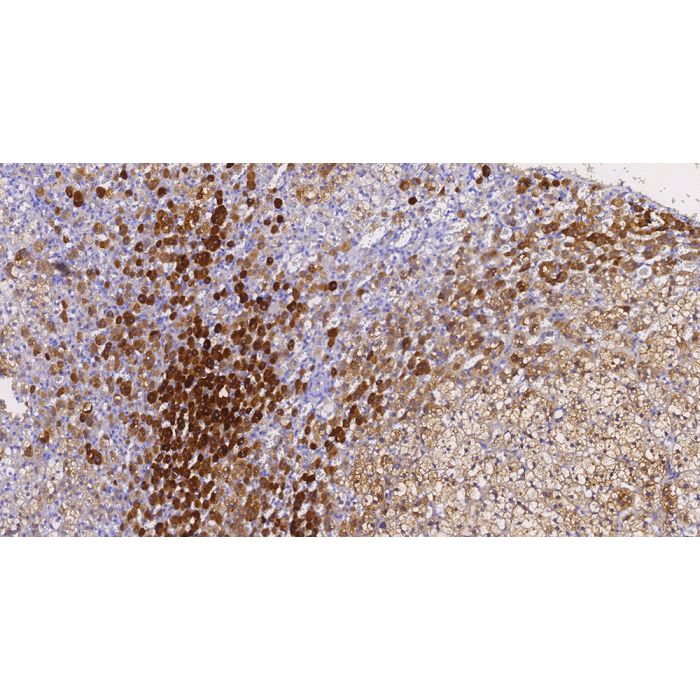
| Image 1 Description | Immunochemical staining of human Inhibin alpha/INHA in Human adrenal gland with mouse monoclonal antibody at 150 μL work solution, formalin-fixed paraffin embedded sections. Cellular localization: Cytoplasm |
| Image 1 URL | Source image |