Recombinant Human ASGPR1 / ASGR1 Protein (Catalog#10773-H07H)
Preparation
This antibody was produced from a hybridoma resulting from the fusion of a mouse myeloma with B cells obtained from a mouse immunized with purified, recombinant Human ASGPR1 / ASGR1 (rh ASGPR1 / ASGR1; Catalog#10773-H07H; P07306; Gln62-Leu291) and conjugated with FITC under optimum conditions, the unreacted FITC was removed.
Source
Monoclonal Mouse IgG1 Clone #02
Purification
Protein A
Formulation
PBS solution containing 0.5% BSA and 0.03%ProClin300
Concentration
10 μl/Test, 0.1 mg/ml
Conjugate
FITC
Form
Liquid
Shipping
This antibody is shipped as liquid solution at ambient temperature. Upon receipt, store it immediately at the temperature recommended below.
Storage
This antibody can be stored at 2℃-8℃ for twelve months without detectable loss of activity. Protected from prolonged exposure to light. Do not freeze !
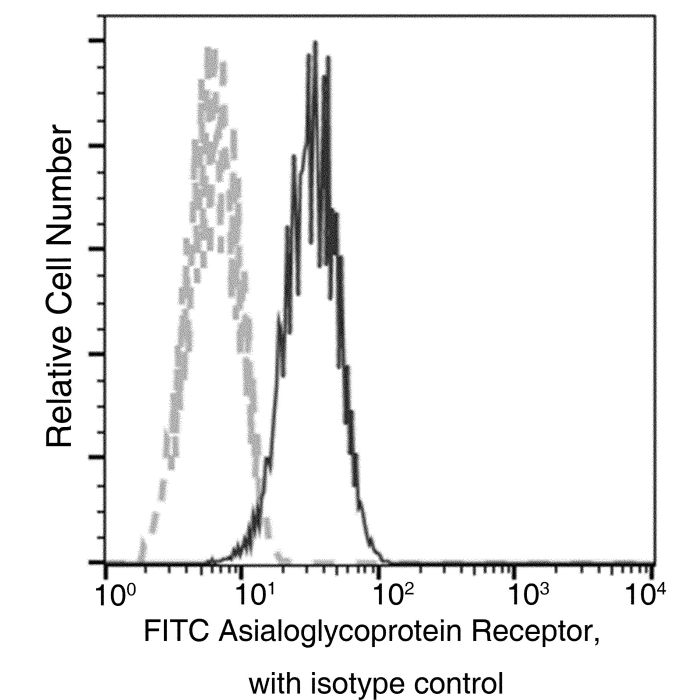
Flow cytometric analysis of Human Asialoglycoprotein Receptor expression on HepG2 cells. Cells were stained with FITC-conjugated anti-Human Asialoglycoprotein Receptor. The fluorescence histograms were derived from gated events with the forward and side light-scatter characteristics of intact cells.
Image 1 Alt Text
Human Asialoglycoprotein Receptor Flow Cytometry (FC) 31519
The asialoglycoprotein receptor (ASGPR), an endocytotic cell surface receptor expressed by hepatocytes, is triggered by triantennary binding to galactose residues of macromolecules such as asialoorosomucoid (ASOR). ASGPR belongs to the long-form subfamily of the C-type/Ca2+ dependent lectin family. It is a complex of two noncovalently-linked and highly homologous subunits, a major 42 kDa glycoprotein ASGPR1(MHL-1) and a minor 51 kDa glycoprotein ASGR2 (MHL-2). ASGPR1 is synthesized as a type II transmembrane protein that contains a cytosolic N-terminal domain, a single transmembrane segment, and an extracellular domain which contains two important structural regions. The first is a stalk domain that contributes to noncovalent oligomerization, and the second is a Ca2+-dependent carbohydrate binding domain at the very C-terminus that is unusually stabilized by three ions. The research regarded that ASGPR1 could be targeted for anti- hepatitis B virus (HBV) drug development.
References
Yang J, et al. (2006) Antisense oligonucleotides targeted against asialoglycoprotein receptor 1 block human hepatitis B virus replication. J Viral Hepat. 13(3): 158-65.
Li Y, et al. (2008) Targeted delivery of macromolecular drugs: asialoglycoprotein receptor (ASGPR) expression by selected hepatoma cell lines used in antiviral drug development. Curr Drug Deliv. 5(4): 299-302.