Recombinant Human CD22 / Siglec-2 Protein (Catalog#11958-H08H)
Preparation
This antibody was produced from a hybridoma resulting from the fusion of a mouse myeloma with B cells obtained from a mouse immunized with purified, recombinant Human CD22 / Siglec-2 (rh CD22 / Siglec-2; Catalog#11958-H08H; P20273-1; Met1-Arg687) and conjugated with FITC under optimum conditions, the unreacted FITC was removed.
Source
Monoclonal Mouse IgG1 Clone #13
Purification
Protein A
Formulation
PBS solution containing 0.5% BSA and 0.09% sodium azide
Concentration
5 μl/Test, 0.1 mg/ml
Conjugate
FITC
Form
Liquid
Shipping
This antibody is shipped as liquid solution at ambient temperature. Upon receipt, store it immediately at the temperature recommended below.
Storage
This antibody can be stored at 2℃-8℃ for twelve months without detectable loss of activity. Protected from prolonged exposure to light. Do not freeze ! Sodium azide is toxic to cells and should be disposed of properly. Flush with large volumes of water during disposal.
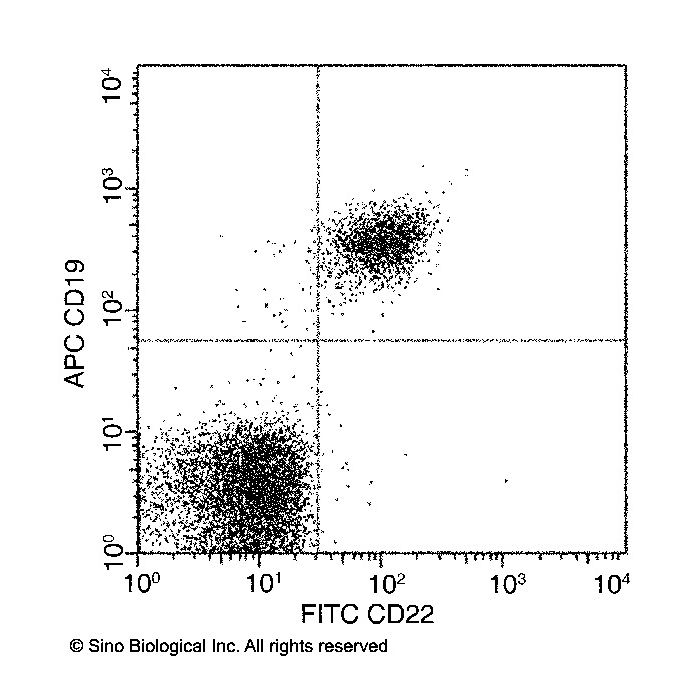
Flow cytometric analysis of Human CD22 expression on human whole blood lymphocytes. Cells were stained with FITC-conjugated anti-Human CD22 and APC-conjugated anti-Human CD19. The dot plots were derived from gated events with the forward and side light-scatter characteristics of viable lymphocytes.
CD22 is a member of the immunoglobulin superfamily, SIGLEC family of lectins. It is first expressed in the cytoplasm of pro-B and pre-B cells, and on the surface as B cells mature to become IgD+. CD22 serves as an adhesion receptor for sialic acid-bearing ligands expressed on erythrocytes and all leukocyte classes. In addition to its potential role as a mediator of intercellular interactions, signal transduction through CD22 can activate B cells and modulate antigen receptor signaling in vitro. The phenotype of CD22-deficient mice suggests that CD22 is primarily involved in the generation of mature B cells within the bone marrow, blood, and marginal zones of lymphoid tissues. CD22 recruits the tyrosine phosphatase Src homology 2 domain-containing phosphatase 1 (SHP-1) to immunoreceptor tyrosine-based inhibitory motifs (ITIMs) and inhibits B-cell receptor (BCR)-induced Ca2+ signaling on normal B cells. CD22 interacts specifically with ligands carrying alpha2-6-linked sialic acids. As an inhibitory coreceptor of the B-cell receptor (BCR), CD22 plays a critical role in establishing signalling thresholds for B-cell activation. Like other coreceptors, the ability of CD22 to modulate B-cell signalling is critically dependent upon its proximity to the BCR, and this in turn is governed by the binding of its extracellular domain to alpha2,6-linked sialic acid ligands. However, genetic studies in mice reveal that some CD22 functions are regulated by ligand binding, whereas other functions are ligand-independent and may only require expression of an intact CD22 cytoplasmic domain at the B-cell surface. CD19 regulates CD22 phosphorylation by augmenting Lyn kinase activity, while CD22 inhibits CD19 phosphorylation via SHP-1.
Research Areas
Cancer Drug Targets
ITIM/ITAM Immunoreceptors and Related Molecules
Related Pathways
B Cell Receptor Signaling Pathway
Tags
Cancer Immunotherapy
Immune Checkpoint
Immunotherapy
Targeted Therapy
References
Tedder TF, et al. (1997) CD22, a B lymphocyte-specific adhesion molecule that regulates antigen receptor signaling. Annu Rev Immunol. 15: 481-504.
Tedder TF, et al. (2005) CD22: a multifunctional receptor that regulates B lymphocyte survival and signal transduction. Adv Immunol. 88: 1-50.
Fujimoto M, et al. (2007) B cell signaling and autoimmune diseases: CD19/CD22 loop as a B cell signaling device to regulate the balance of autoimmunity. J Dermatol Sci. 46(1): 1-9.
Walker JA, et al. (2008) CD22: an inhibitory enigma. Immunology. 123(3): 314-25.
Nitschke L. (2009) CD22 and Siglec-G: B-cell inhibitory receptors with distinct functions. Immunol Rev. 230(1): 128-43.