
Anti-ASGR1 Antibody, Rabbit Polyclonal sinobiological 10773-T54
$243.00
In stock
SKU
10773-T54
| Catalog No. | Size | Price (USD) |
| 10773-T54-100 | 100 µL | $251.64 |
| Catalog No. | Size | Price (USD) |
| 10773-T54-100 | 100 µL | $251.64 |
General Information
| Product name | Anti-ASGR1 Antibody, Rabbit Polyclonal |
| Validated applications | WB (FAQ Protocol), ELISA (FAQ Protocol), ICC/IF (FAQ Protocol), IP (FAQ Protocol) |
| Species reactivity | Reacts with: Human |
| Specificity | Human ASGR1 |
| Immunogen | Recombinant Human ASGR1 Protein (Catalog#10773-H07H) |
| Preparation | Produced in rabbits immunized with purified, recombinant Human ASGR1 (rh ASGR1; Catalog#10773-H07H; P07306; Gln62-Leu291). ASGR1 specific IgG was purified by Human ASGR1 affinity chromatography. |
| Source | Polyclonal Rabbit IgG |
| Purification | Protein A & Antigen Affinity |
| Formulation | 0.2 μm filtered solution in PBS |
| Conjugate | Unconjugated |
| Form | Liquid |
| Shipping | This antibody is shipped as liquid solution at ambient temperature. Upon receipt, store it immediately at the temperature recommended below. |
| Storage | This antibody can be stored at 2℃-8℃ for one month without detectable loss of activity. Antibody products are stable for twelve months from date of receipt when stored at -20℃ to -80℃. Preservative-Free. Avoid repeated freeze-thaw cycles. |
Synonyms: Anti-ASGPR Antibody; Anti-ASGPR1 Antibody; Anti-CLEC4H1 Antibody; Anti-HL-1 Antibody
Image / Experimental Information
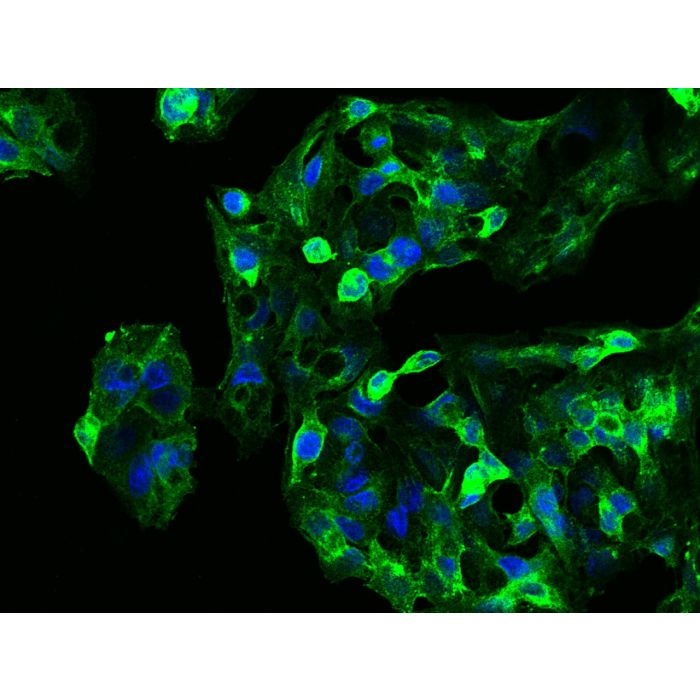
| Image 1 Description | Immunofluorescence staining of His-ASGR1 in HepG2 cells. Cells were fixed with 4% PFA, permeabilzed with 0.3% Triton X-100 in PBS,blocked with 10% serum, and incubated with rabbit anti-Human His-ASGR1 polyclonal antibody (dilution ratio 1:100) at 4℃ overnight. Then cells were stained with the Alexa Fluor®488-conjugated Goat Anti-rabbit IgG secondary antibody (green) and counterstained with DAPI (blue).Positive staining was localized to Cytoplasm and Cell membrane. |
| Image 1 Alt Text | Human ASGR1 Immunofluorescence(IF) 39098 |
| Image 1 URL | Source image |
| Image 2 Description | Immunofluorescence staining of His-ASGR1 in HepG2 cells. Cells were fixed with 4% PFA, permeabilzed with 0.3% Triton X-100 in PBS,blocked with 10% serum, and incubated with rabbit anti-Human His-ASGR1 polyclonal antibody (dilution ratio 1:100) at 4℃ overnight. Then cells were stained with the Alexa Fluor®488-conjugated Goat Anti-rabbit IgG secondary antibody (green) and counterstained with DAPI (blue).Positive staining was localized to Cytoplasm and Cell membrane. |
| Image 2 Alt Text | Human ASGR1 Immunoprecipitation(IP) 39105 |
| Image 2 URL | Source image |
| Image 3 Description | Immunofluorescence staining of His-ASGR1 in HepG2 cells. Cells were fixed with 4% PFA, permeabilzed with 0.3% Triton X-100 in PBS,blocked with 10% serum, and incubated with rabbit anti-Human His-ASGR1 polyclonal antibody (dilution ratio 1:100) at 4℃ overnight. Then cells were stained with the Alexa Fluor®488-conjugated Goat Anti-rabbit IgG secondary antibody (green) and counterstained with DAPI (blue).Positive staining was localized to Cytoplasm and Cell membrane. |
| Image 3 Alt Text | Human ASGR1 Western blot (WB) 39108 |
| Image 3 URL | Source image |
Background Information
| Full Name | asialoglycoprotein receptor 1 |
| Description | The asialoglycoprotein receptor (ASGPR), an endocytotic cell surface receptor expressed by hepatocytes, is triggered by triantennary binding to galactose residues of macromolecules such as asialoorosomucoid (ASOR). ASGPR belongs to the long-form subfamily of the C-type/Ca2+ dependent lectin family. It is a complex of two noncovalently-linked and highly homologous subunits, a major 42 kDa glycoprotein ASGPR1(MHL-1) and a minor 51 kDa glycoprotein ASGR2 (MHL-2). ASGPR1 is synthesized as a type II transmembrane protein that contains a cytosolic N-terminal domain, a single transmembrane segment, and an extracellular domain which contains two important structural regions. The first is a stalk domain that contributes to noncovalent oligomerization, and the second is a Ca2+-dependent carbohydrate binding domain at the very C-terminus that is unusually stabilized by three ions. The research regarded that ASGPR1 could be targeted for anti- hepatitis B virus (HBV) drug development. |
| References |
|
-HD17OC2313-100-HepG2-IF.png)

-HD17OC2313-WB.png)