Recombinant Human CD40 / TNFRSF5 protein (Catalog#10774-H08H)
Preparation
This antibody was produced from a hybridoma resulting from the fusion of a mouse myeloma with B cells obtained from a mouse immunized with purified, recombinant Human CD40 / TNFRSF5 (rh CD40 / TNFRSF5; Catalog#10774-H08H; NP_001241.1; Met1-Arg193) and conjugated with PE under optimum conditions, the unreacted PE was removed.
Source
Monoclonal Mouse IgG2b Clone #17
Purification
Protein A
Formulation
PBS solution containing 0.5% BSA and 0.09% sodium azide
Concentration
1 μl/Test, 0.1 mg/ml
Conjugate
PE
Form
Liquid
Shipping
This antibody is shipped as liquid solution at ambient temperature. Upon receipt, store it immediately at the temperature recommended below.
Storage
This antibody can be stored at 2℃-8℃ for twelve months without detectable loss of activity. Protected from prolonged exposure to light. Do not freeze ! Sodium azide is toxic to cells and should be disposed of properly. Flush with large volumes of water during disposal.
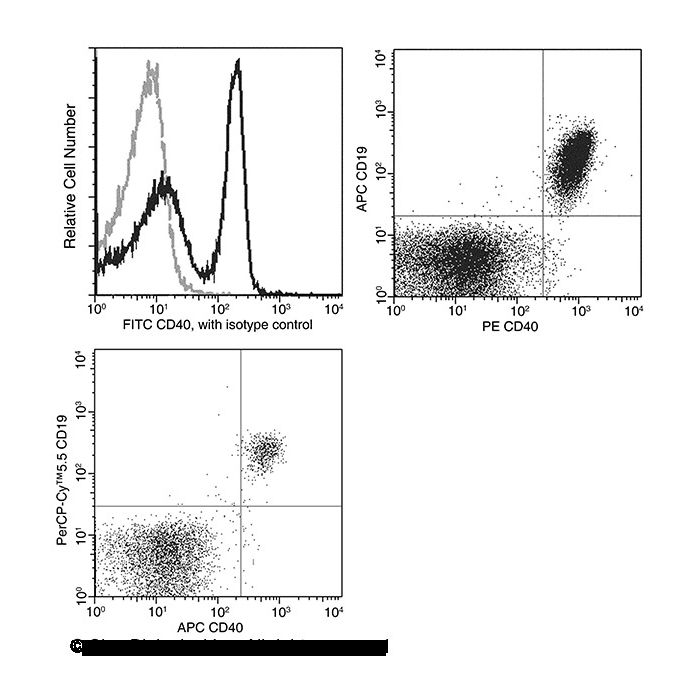
Flow cytometric analysis of human CD40 expression on human whole blood lymphocytes. Human whole blood lymphocytes were stained with PE-conjugated anti-Human CD40 and APC-conjugated anti-Human CD19(BD Pharmingen™). The histogram were derived from gated events with the forward and side light-scatter characteristics of viable lymphocytes.
CD40, also known as TNFRSF5, is a member of the TNF receptor superfamily which are single transmembrane-spanning glycoproteins. CD40 protein plays an essential role in mediating a broad variety of immune and inflammatory responses including T cell-dependent immunoglobulin class switching, memory B cell development, and germinal center formation. CD40 protein is expressed in B cells, dendritic cells, macrophages, endothelial cells, and several tumor cell lines. Defects in CD40 result in hyper-IgM immunodeficiency type 3 (HIGM3). In addition, CD40/CD40L interaction is found to be necessary for amyloid-beta-induced microglial activation, and thus is thought to be an early event in Alzheimer disease pathogenesis.
Research Areas
Cancer Drug Targets
Related Pathways
B Cell Receptor Signaling Pathway
Tags
Cancer Immunotherapy
Co-stimulatory Immune Checkpoint Targets
Immune Checkpoint
Immune Checkpoint Detection: Antibodies
Immune Checkpoint Detection: ELISA Antibodies
Immune Checkpoint Detection: FCM Antibodies
Immune Checkpoint Detection: ICC Antibodies
Immune Checkpoint Detection: IP Antibodies
Immune Checkpoint Detection: WB Antibodies
Immune Checkpoint Proteins
Immune Checkpoint Targets
Immunotherapy
Targeted Therapy
References
van Kooten C, et al. (2000). CD40-CD40 ligand. J Leukoc Biol. 67 (1): 2-17.
Bhushan A, et al. (2002). CD40:CD40L interactions in X-linked and non-X-linked hyper-IgM syndromes. Immunol Res. 24 (3): 311-24.
Chatzigeorgiou A, et al. (2009) CD40/CD40L signaling and its implication in health and disease. Biofactors. 35(6): 474-83.
Li R, et al. (2009) Expression of CD40 and CD40L in Gastric Cancer Tissue and Its Clinical Significance. Int J Mol Sci. 10(9): 3900-17.
Lievens D, et al. (2009) The multi-functionality of CD40L and its receptor CD40 in atherosclerosis. Thromb Haemost. 102(2): 206-14.