Recombinant Human CD44 protein (Catalog#12211-H08H)
Preparation
This antibody was produced from a hybridoma resulting from the fusion of a mouse myeloma with B cells obtained from a mouse immunized with purified, recombinant Human CD44 (rh CD44; Catalog#12211-H08H; P16070-1; Met1-Pro220). The IgG fraction of the cell culture supernatant was purified by Protein A affinity chromatography.
Source
Monoclonal Mouse IgG1 Clone #02
Purification
Protein A
Formulation
0.2 μm filtered solution in PBS
Conjugate
Unconjugated
Form
Liquid
Shipping
This antibody is shipped as liquid solution at ambient temperature. Upon receipt, store it immediately at the temperature recommended below.
Storage
This antibody can be stored at 2℃-8℃ for one month without detectable loss of activity. Antibody products are stable for twelve months from date of receipt when stored at -20℃ to -80℃. Preservative-Free. Avoid repeated freeze-thaw cycles.
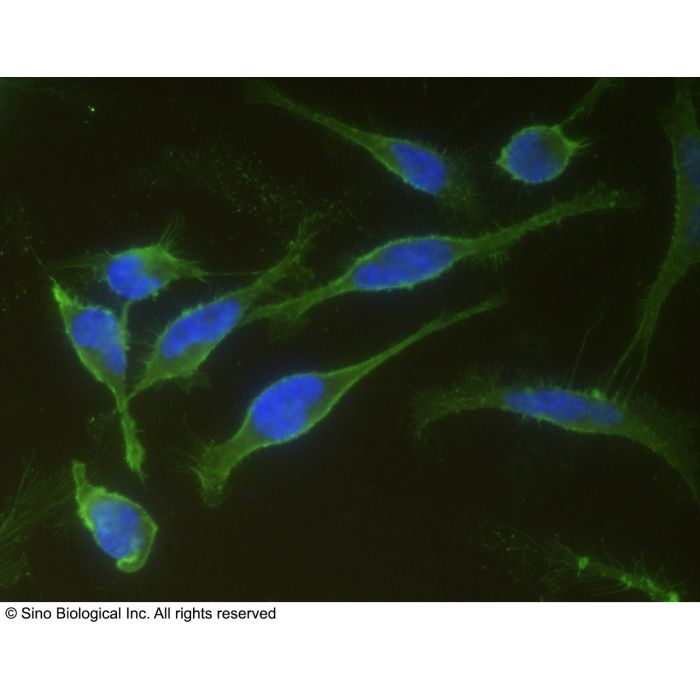
Immunofluorescence staining of Human CD44 in Hela cells. Cells were fixed with 4% PFA, blocked with 10% serum, and incubated with Mouse anti-Human CD44 monoclonal antibody (1:60) at 37℃ 1 hour. Then cells were stained with the Alexa Fluor® 488-conjugated Goat Anti-mouse IgG secondary antibody (green) and counterstained with DAPI (blue). Positive staining was localized to cell membrane and cytoplasm.
Immunofluorescence staining of Human CD44 in Hela cells. Cells were fixed with 4% PFA, blocked with 10% serum, and incubated with Mouse anti-Human CD44 monoclonal antibody (1:60) at 37℃ 1 hour. Then cells were stained with the Alexa Fluor® 488-conjugated Goat Anti-mouse IgG secondary antibody (green) and counterstained with DAPI (blue). Positive staining was localized to cell membrane and cytoplasm.
CD44 is a type I transmembrane protein and a member of the cartilage link protein family. It is involved in cell-cell and cell-matrix interactions and signal transduction. Several CD44 ligands have been identified. The most extensively characterized ligand for CD44 is hyaluronan, a component of the extracellular matrix. CD44 protein is expressed on the majority of immune cells. The binding of CD44 to hyaluronan is induced on T lymphocytes after activation by antigen and on monocytes after stimulation by inflammatory agents. Under inflammatory conditions, CD44 on endothelial cells presents hyaluronan to CD44 on activated T lymphocytes and mediates a rolling interaction under flow conditions. Perturbations of the hyaluronan-CD44 interaction at the plasma membrane by various antagonists result in attenuation of receptor tyrosine kinase and transporter activities and inhibition of tumor progression in vivo. CD44 is known to interact with the ezrin family (ERM family) members and form a complex that plays diverse roles within both normal and abnormal cells, particularly cancer cells. CD44 and ezrin and their respective complex have properties suggesting that they may be important in the process of tumour-endothelium interactions, cell migrations, cell adhesion, tumour progression and metastasis.
References
Bajorath J. (2000) Molecular organization, structural features, and ligand binding characteristics of CD44, a highly variable cell surface glycoprotein with multiple functions. Proteins. 39(2): 103-11.
Johnson P, et al. (2000) A role for the cell adhesion molecule CD44 and sulfation in leukocyte-endothelial cell adhesion during an inflammatory response? Biochem Pharmacol. 59(5): 455-65.
Martin TA, et al. (2003) The role of the CD44/ezrin complex in cancer metastasis. Crit Rev Oncol Hematol. 46(2): 165-86.
Toole BP, et al. (2008) Hyaluronan, CD44 and Emmprin: partners in cancer cell chemoresistance. Drug Resist Updat. 11(3): 110-21.
Johnson P, et al. (2009) CD44 and its role in inflammation and inflammatory diseases. Inflamm Allergy Drug Targets. 8(3): 208-20.