Recombinant Human LFA-3 / CD58 Protein (Catalog#12409-H08H)
Preparation
This antibody was produced from a hybridoma resulting from the fusion of a mouse myeloma with B cells obtained from a mouse immunized with purified, recombinant Human LFA-3 / CD58 (rh LFA-3 / CD58; Catalog#12409-H08H; AAH05930.1; Met1-Arg215) and conjugated with PerCP under optimum conditions, the unreacted PerCP was removed.
Source
Monoclonal Mouse IgG1 Clone #05
Purification
Protein A
Formulation
PBS solution containing 0.5% BSA and 0.09% sodium azide
Concentration
10 μl/Test, 0.1 mg/ml
Conjugate
PerCP
Form
Liquid
Shipping
This antibody is shipped as liquid solution at ambient temperature. Upon receipt, store it immediately at the temperature recommended below.
Storage
This antibody can be stored at 2℃-8℃ for twelve months without detectable loss of activity. Protected from prolonged exposure to light. Do not freeze ! Sodium azide is toxic to cells and should be disposed of properly. Flush with large volumes of water during disposal.
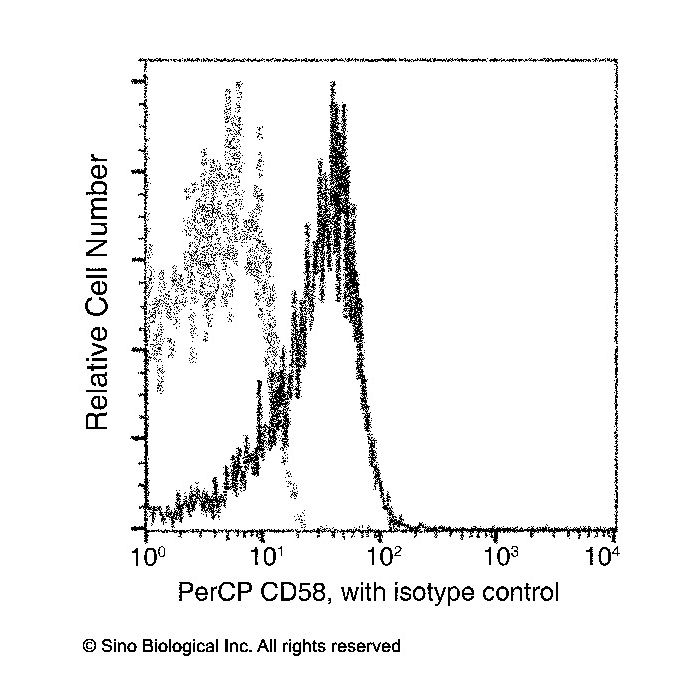
Flow cytometric analysis of Human CD58 expression on human whole blood lymphocytes. Cells were stained with PerCP-conjugated anti-Human CD58. The fluorescence histograms were derived from gated events with the forward and side light-scatter characteristics of viable lymphocytes.
CD58, also known as lymphocyte function-associated antigen 3 (LFA-3), is a 65–70 kDa glycoprotein belonging to the CD2 family of the immunoglobulin superfamily. It serves as the sole ligand for CD2, a receptor primarily expressed on T cells, NK cells, and dendritic cells. CD58 exists in two membrane-anchored forms—transmembrane and GPI-linked—and is widely distributed across both hematopoietic and non-hematopoietic tissues, including leukocytes, erythrocytes, endothelial cells, epithelial cells, and fibroblasts. The CD2–CD58 interaction plays a central role in the immunological synapse, mediating T cell adhesion, co-stimulatory activation, cytokine production, and cytotoxic activity. A soluble form of CD58 (sCD58) has also been identified, which acts as an immunosuppressive factor by disrupting CD2–CD58 binding.
Tags
Cancer Immunotherapy
Immune Checkpoint
Immunotherapy
Targeted Therapy
References
Rochelle JM. et al., 1993, Int Immunol. 5 (2): 209-16.
Virtaneva KI. et al., 1993, Immunogenetics. 37 (6): 461-5.
Horejsí V. et al., 1991, FEBS Lett. 288 (1-2): 1-4.