Recombinant Human LFA-3 / CD58 Protein (Catalog#12409-H08H)
Preparation
This antibody was obtained from a rabbit immunized with purified, recombinant Human LFA-3 / CD58 (rh LFA-3 / CD58; Catalog#12409-H08H; AAH05930.1; Met1-Arg215).
Source
Monoclonal Rabbit IgG Clone #085
Purification
Protein A
Formulation
0.2 μm filtered solution in PBS
Conjugate
Unconjugated
Form
Liquid
Shipping
This antibody is shipped as liquid solution at ambient temperature. Upon receipt, store it immediately at the temperature recommended below.
Storage
This antibody can be stored at 2℃-8℃ for one month without detectable loss of activity. Antibody products are stable for twelve months from date of receipt when stored at -20℃ to -80℃. Preservative-Free. Avoid repeated freeze-thaw cycles.
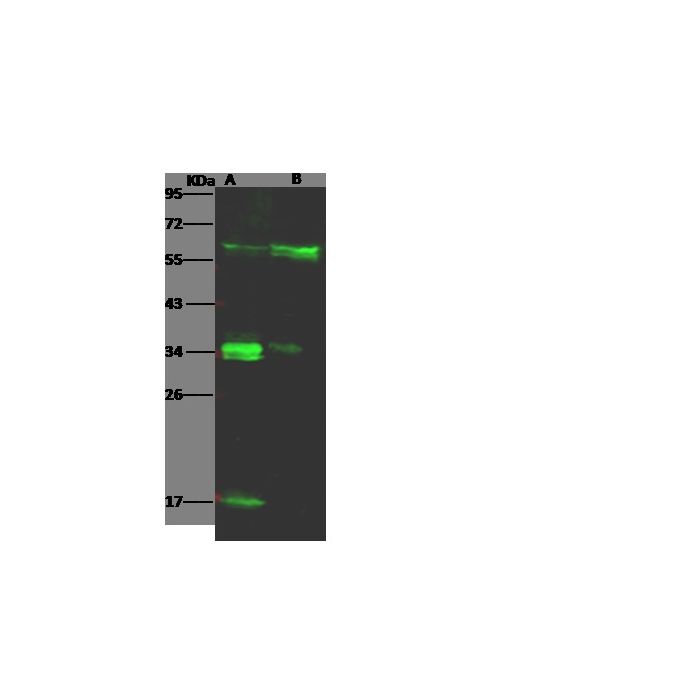
Anti-CD58 rabbit monoclonal antibody at 1:500 dilution Lane A: Jurkat Whole Cell Lysate Lane B: K562 Whole Cell Lysate Lysates/proteins at 30 μg per lane. Secondary Goat Anti-Rabbit IgG H&L (Dylight800) at 1/10000 dilution. Developed using the Odyssey technique. Performed under reducing conditions. Predicted band size:28 kDa Observed band size:61 kDa (We are unsure as to the identity of these extra bands.)
Anti-CD58 rabbit monoclonal antibody at 1:500 dilution Lane A: Jurkat Whole Cell Lysate Lane B: K562 Whole Cell Lysate Lysates/proteins at 30 μg per lane. Secondary Goat Anti-Rabbit IgG H&L (Dylight800) at 1/10000 dilution. Developed using the Odyssey technique. Performed under reducing conditions. Predicted band size:28 kDa Observed band size:61 kDa (We are unsure as to the identity of these extra bands.)
CD58, also known as lymphocyte function-associated antigen 3 (LFA-3), is a 65–70 kDa glycoprotein belonging to the CD2 family of the immunoglobulin superfamily. It serves as the sole ligand for CD2, a receptor primarily expressed on T cells, NK cells, and dendritic cells. CD58 exists in two membrane-anchored forms—transmembrane and GPI-linked—and is widely distributed across both hematopoietic and non-hematopoietic tissues, including leukocytes, erythrocytes, endothelial cells, epithelial cells, and fibroblasts. The CD2–CD58 interaction plays a central role in the immunological synapse, mediating T cell adhesion, co-stimulatory activation, cytokine production, and cytotoxic activity. A soluble form of CD58 (sCD58) has also been identified, which acts as an immunosuppressive factor by disrupting CD2–CD58 binding.
Tags
Cancer Immunotherapy
Immune Checkpoint
Immunotherapy
Targeted Therapy
References
Rochelle JM. et al., 1993, Int Immunol. 5 (2): 209-16.
Virtaneva KI. et al., 1993, Immunogenetics. 37 (6): 461-5.
Horejsí V. et al., 1991, FEBS Lett. 288 (1-2): 1-4.