Recombinant Human CD63 protein (Catalog#11271-H08H)
Preparation
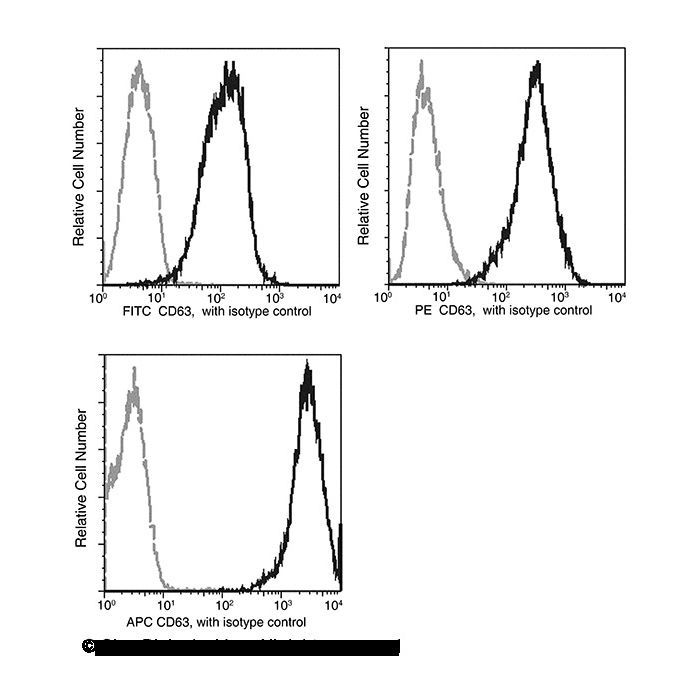
This antibody was produced from a hybridoma resulting from the fusion of a mouse myeloma with B cells obtained from a mouse immunized with purified, recombinant Human CD63 (rh CD63; Catalog#11271-H08H; P08962-1; Ala 103-Val 203) and conjugated with FITC under optimum conditions, the unreacted FITC was removed.
Source
Monoclonal Mouse IgG1 Clone #03
Purification
Protein A
Formulation
PBS solution containing 0.5% BSA and 0.03%ProClin300
Concentration
10 μl/Test, 0.1 mg/ml
Conjugate
FITC
Form
Liquid
Shipping
This antibody is shipped as liquid solution at ambient temperature. Upon receipt, store it immediately at the temperature recommended below.
Storage
This antibody can be stored at 2℃-8℃ for twelve months without detectable loss of activity. Protected from prolonged exposure to light. Do not freeze !
The cluster of differentiation (CD) system is commonly used as cell markers in Immunophenotyping. Different kinds of cells in the immune system can be identified through the surface CD molecules which associating with the immune function of the cell. There are more than 320 CD unique clusters and subclusters have been identified. Some of the CD molecules serve as receptors or ligands important to the cell through initiating a signal cascade which then alter the behavior of the cell. Some CD proteins do not take part in cell signal process but have other functions such as cell adhesion. Cluster of differentiation 63 (CD63) is a member of the CD family and the transmembrane 4 superfamily, also known as the tetraspanin family. CD63 is a cell surface glycoprotein characterized by the presence of four hydrophobic domains. CD63 had functions in mediating signal transduction processes and then regulate a variety of cellular processes such as cell proliferation, activation and motility. It has been reported that CD63 protein associated with tumor progression and served as a blood platelet activation marker and the deficiency of this protein may be associated with Hermansky-Pudlak syndrome.
References
Zola H, et al. (2007) CD molecules 2006-human cell differentiation molecules. J Immunol Methods. 318 (1-2): 1-5.
Ho IC, et al. (2009) GATA3 and the T-cell lineage: essential functions before and after T-helper-2-cell differentiation. Nat Rev Immunol. 9 (2): 125-35.
Matesanz-Isabel J, et al. (2011) New B-cell CD molecules. Immunology Letters.134 (2): 104-12.
Radford KJ, et al. (1996) Associates with Transmembrane 4 Superfamily Members, CD9 and CD81, and with beta 1 Integrins in Human Melanoma. Biochemical Biophysical Research Communications. 222(1): 13-18.
Metzelaar MJ, et al. (1991) CD63 antigen, A novel lysosomal membrane glycoprotein, cloned by a screening procedure for intracellular antigens in eukaryotic cells. The journal of biological chemistry. 266: 3239-45.