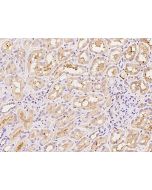
Recombinant Human CD68 protein (Catalog#11192-H08B1)
Preparation
This antibody was obtained from a rabbit immunized with purified, recombinant Human CD68 (rh CD68; Catalog#11192-H08B1; P34810-1; Met1-Ser319).
Source
Monoclonal Rabbit IgG Clone #039
Purification
Protein A
Formulation
0.2 μm filtered solution in PBS
Conjugate
Unconjugated
Form
Liquid
Shipping
This antibody is shipped as liquid solution at ambient temperature. Upon receipt, store it immediately at the temperature recommended below.
Storage
This antibody can be stored at 2℃-8℃ for one month without detectable loss of activity. Antibody products are stable for twelve months from date of receipt when stored at -20℃ to -80℃. Preservative-Free. Avoid repeated freeze-thaw cycles.
Macrosialin, also known as CD68 and Gp11, is a single-pass type I membrane protein which belongs to theLAMP family. CD68 is highly expressed by blood monocytes and tissue macrophages. It is also expressed in lymphocytes, fibroblasts and endothelial cells. CD68 is expressed in many tumor cell lines which could allow them to attach to selectins on vascular endothelium, facilitating their dissemination to secondary sites. CD68 plays a role in phagocytic activities of tissue macrophages, both in intracellular lysosomal metabolism and extracellular cell-cell and cell-pathogen interactions. It is a commonly used marker for macrophages. However, a number of studies have shown that CD68 antibodies react with other hematopoietic and non-hematopoietic cell types, suggesting that CD68 may not be a macrophage-specific antigen. CD68 binds to tissue- and organ-specific lectins or selectins, allowing homing of macrophage subsets to particular sites. Rapid recirculation of CD68 from endosomes and lysosomes to the plasma membrane may allow macrophages to crawl over selectin-bearing substrates or other cells.
References
Strobl H. et al., 1995, Br J Haematol. 90 (4): 774-82.
Ogawa Y. et al., 1995, Pathol Int. 45 (9): 698-701.
Sadovnikova E. et al., 2002,Leukemia. 16 (10): 2019-26.
Gottfried E. et al., 2008, Scand J Immunol. 67 (5): 453-63.
Strojnik T. et al., 2009, Anticancer Res. 29 (8): 3269-79.