Recombinant Human CD81/TAPA1 Protein (Catalog#14244-HNCH)
Preparation
This antibody was produced from a hybridoma resulting from the fusion of a mouse myeloma with B cells obtained from a mouse immunized with purified, recombinant Human CD81/TAPA1 (rh CD81/TAPA1; Catalog#14244-HNCH; NP_004347.1; Phe113-Lys201) and conjugated with APC under optimum conditions, the unreacted APC was removed.
Source
Monoclonal Mouse IgG2b Clone #03
Purification
Protein A
Formulation
PBS solution containing 0.5% BSA and 0.09% sodium azide
Concentration
5 μl/Test, 0.1 mg/ml
Conjugate
APC
Form
Liquid
Shipping
This antibody is shipped as liquid solution at ambient temperature. Upon receipt, store it immediately at the temperature recommended below.
Storage
This antibody can be stored at 2℃-8℃ for twelve months without detectable loss of activity. Protected from prolonged exposure to light. Do not freeze ! Sodium azide is toxic to cells and should be disposed of properly. Flush with large volumes of water during disposal.
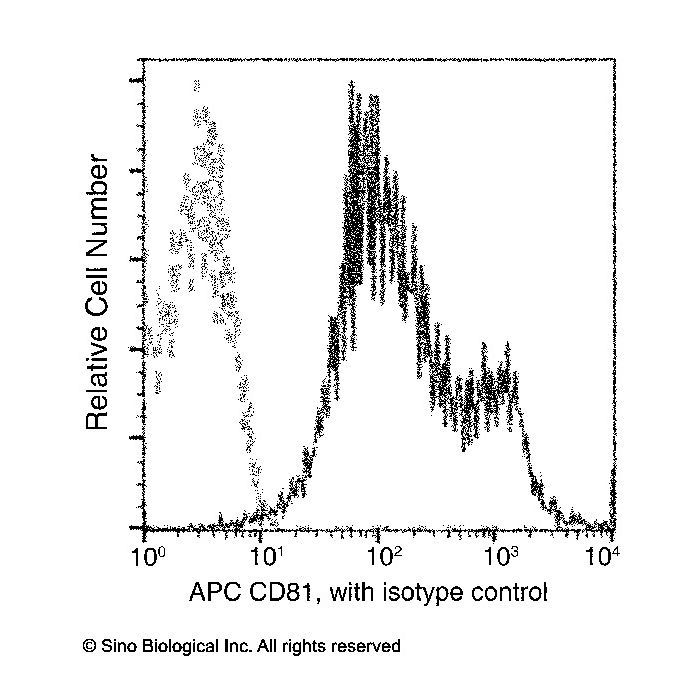
Flow cytometric analysis of Human CD81 expression on human whole blood lymphocytes. Cells were stained with APC-conjugated anti-Human CD81. The fluorescence histograms were derived from gated events with the forward and side light-scatter characteristics of viable lymphocytes.
CD81, also known as TAPA-1, belongs to the transmembrane 4 superfamily, also known as the tetraspanin family. Members of this family mediate signal transduction events that play a role in the regulation of cell development, activation, growth and motility.CD81 is a widely expressed cell-surface protein involved in an astonishing variety of biologic responses. It is related to adhesion, morphology, activation, proliferation, and differentiation of B, T, and other cells. On B cells CD81 is part of a complex with CD21, CD19, and Leu13. This complex reduces the threshold for B cell activation via the B cell receptor by bridging Ag specific recognition and CD21-mediated complement recognition.
References
Petracca R. et al., 2000, J Virol. 74 (10): 4824-30.
Bartosch B. et al., 2003, The Journal of Biological Chemistry. 278 (43): 41624-30.
Clark KL. et al., 2001, Journal of Immunology. 167 (9): 5115-21.