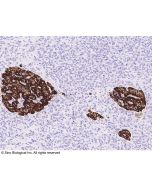
Recombinant Human CD82 / KAI-1 Protein (Catalog#12275-H08H)
Preparation
This antibody was obtained from a rabbit immunized with purified, recombinant Human CD82 / KAI-1 (rh CD82 / KAI-1; Catalog#12275-H08H; P27701-1; Gly111-Leu228).
Source
Monoclonal Rabbit IgG Clone #072
Purification
Protein A
Formulation
0.2 μm filtered solution in PBS
Conjugate
Unconjugated
Form
Liquid
Shipping
This antibody is shipped as liquid solution at ambient temperature. Upon receipt, store it immediately at the temperature recommended below.
Storage
This antibody can be stored at 2℃-8℃ for one month without detectable loss of activity. Antibody products are stable for twelve months from date of receipt when stored at -20℃ to -80℃. Preservative-Free. Avoid repeated freeze-thaw cycles.
CD82, also known as KAI-1, structurally belongs to tetraspanin family while categorised as metastasis suppressor gene on functional grounds. KAI1/CD82 is localized on cell membrane and form interactions with other tetraspanins, integrins and chemokines which are respectively responsible for cell migration, adhesion and signalling. Downregulation of CD82 expression is associated with the advanced stages of many human cancers and correlates with the acquisition of metastatic potential. Recent studies suggest that complex mechanisms underlie CD82 loss of function, including altered transcriptional regulation, splice variant production and post-translational protein modifications, and indicate a central role for CD82 in controlling metastasis as a 'molecular facilitator'. The loss of KAI1/CD82 expression in invasive and metastatic cancers is due to a complex, epigenetic mechanism that probably involves transcription factors such as NFkappaB, p53, and beta-catenin. A loss of KAI1 expression is also associated with the advanced stages of many human malignancies and results in the acquisition of invasive and metastatic capabilities by tumour cells. Thus, KAI1/CD82 is regarded as a wide-spectrum tumor metastasis suppressor.
References
Malik FA, et al. (2009) KAI-1/CD82, the molecule and clinical implication in cancer and cancer metastasis. Histol Histopathol. 24(4): 519-30.
Liu WM, et al. (2006) KAI1/CD82, a tumor metastasis suppressor. Cancer Lett. 240(2): 183-94.
Tonoli H, et al. (2006) CD82 metastasis suppressor gene: a potential target for new therapeutics? Trends Mol Med. 11(12): 563-70.
Jackson P, et al. (2005) KAI1 tetraspanin and metastasis suppressor. Int J Biochem Cell Biol. 37(3): 530-4.