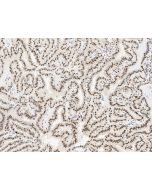
Human Mouse, Rat (Species predicted to react based on 100% sequence homology)
Immunogen
A synthetic peptide corresponding to the C-terminus of the Human CDK2
Preparation
Produced in rabbits immunized with a synthetic peptide corresponding to the C-terminus of the Human CDK2, and purified by antigen affinity chromatography.
Source
Polyclonal Rabbit IgG
Purification
Protein A & Antigen Affinity
Formulation
0.2 μm filtered solution in PBS
Conjugate
Unconjugated
Form
Liquid
Shipping
This antibody is shipped as liquid solution at ambient temperature. Upon receipt, store it immediately at the temperature recommended below.
Storage
This antibody can be stored at 2℃-8℃ for one month without detectable loss of activity. Antibody products are stable for twelve months from date of receipt when stored at -20℃ to -80℃. Preservative-Free. Avoid repeated freeze-thaw cycles.
CDK2 is a member of the Ser/Thr protein kinase family. This protein kinase is highly similar to the gene products of S. cerevisiae cdc28, and S. pombe cdc2. It is a catalytic subunit of the cyclin-dependent protein kinase complex, whose activity is restricted to the G1-S phase, and essential for cell cycle G1/S phase transition. Cdks (cyclin-dependent kinases) are heteromeric serine/threonine kinases that control progression through the cell cycle in concert with their regulatory subunits, the cyclins. Cdks are constitutively expressed and are regulated by several kinases and phosphastases, including Wee1, CDK-activating kinase and Cdc25 phosphatase. Although there are 12 different cdk genes, only 5 have been shown to directly drive the cell cycle (Cdk1, -2, -3, -4, and -6). Following extracellular mitogenic stimuli, cyclin D gene expression is upregulated. Cdk4 forms a complex with cyclin D and phosphorylates Rb protein, leading to liberation of the transcription factor E2F. E2F induces transcription of genes including cyclins A and E, DNA polymerase and thymidine kinase. Cdk4-cyclin E complexes form and initiate G1/S transition. Subsequently, Cdk1-cyclin B complexes form and induce G2/M phase transition. Cdk1-cyclin B activation induces the breakdown of the nuclear envelope and the initiation of mitosis. CDK2 associates with and regulated by the regulatory subunits of the complex including cyclin A or E, CDK inhibitor p21Cip1 (CDKN1A) and p27Kip1 (CDKN1B). Its activity is also regulated by its protein phosphorylation. CDK2 is involved in the control of the cell cycle. It also interacts with cyclins A, B1, B3, D, or E. Activity of CDK2 is maximal during S phase and G2.
Related Pathways
p53 Pathway
References
Bao ZQ, et al. (2011) Briefly bound to activate: transient binding of a second catalytic magnesium activates the structure and dynamics of CDK2 kinase for catalysis. Structure. 19(5):675-90.
Neganova I, et al. (2011) An important role for CDK2 in G1 to S checkpoint activation and DNA damage response in human embryonic stem cells. Stem Cells. 29(4):651-9.
Li J, et al. (2011) Phosphorylation of MCM3 protein by cyclin E/cyclin-dependent kinase 2 (Cdk2) regulates its function in cell cycle. J Biol Chem. 286(46):39776-85.
Buis J, et al. (2012) Mre11 regulates CtIP-dependent double-strand break repair by interaction with CDK2. Nat Struct Mol Biol. 19(2):246-52.