Recombinant Human Clusterin / Apolipoprotein J / Apo-J protein (Catalog#11297-H08H)
Preparation
This antibody was produced from a hybridoma resulting from the fusion of a mouse myeloma with B cells obtained from a mouse immunized with purified, recombinant Human Clusterin / Apolipoprotein J / Apo-J (rh Clusterin / Apolipoprotein J / Apo-J; Catalog#11297-H08H; NP_001822.2; Met1-Glu501) and conjugated with FITC under optimum conditions, the unreacted FITC was removed.
Source
Monoclonal Mouse IgG1 Clone #01
Purification
Protein A
Formulation
PBS solution containing 0.5% BSA and 0.09% sodium azide
Concentration
10 μl/Test, 0.1 mg/ml
Conjugate
FITC
Form
Liquid
Shipping
This antibody is shipped as liquid solution at ambient temperature. Upon receipt, store it immediately at the temperature recommended below.
Storage
This antibody can be stored at 2℃-8℃ for twelve months without detectable loss of activity. Protected from prolonged exposure to light. Do not freeze ! Sodium azide is toxic to cells and should be disposed of properly. Flush with large volumes of water during disposal.
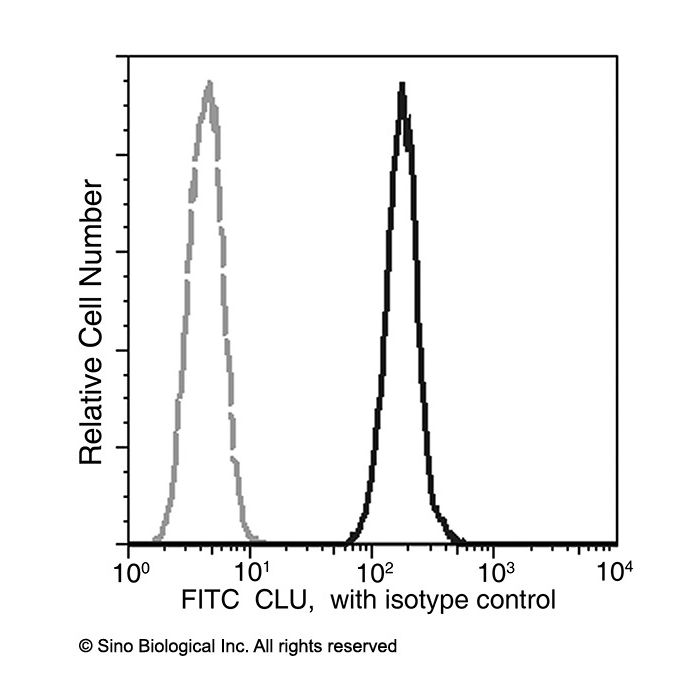
Flow cytometric analysis of Human CLU expression in A549 cells. The cells were treated according to manufacturer’s manual (BD Pharmingen™ Cat. No. 554714), and then stained with FITC Mouse anti-Human CLU. The fluorescence histograms were derived from gated events with the forward and side light-scatter characteristics of intact cells.
Clusterin, also known as complement-associated protein SP-40, Complement cytolysis inhibitor, Apolipoprotein J, Testosterone-repressed prostate message 2, Aging-associated gene 4 protein, CLU and APOJ, is a secreted protein which belongs to the clusterin family. Clusterin/Apolipoprotein J/Apo-J is an enigmatic glycoprotein with a nearly ubiquitous tissue distribution and an apparent involvement in biological processes ranging from mammary gland involution to neurodegeneration in Alzheimer's disease. Its major form, a heterodimer, is secreted and present in physiological fluids, but truncated forms targeted to the nucleus have also been identified. Clusterin/Apolipoprotein J/Apo-J is a widely distributed glycoprotein with a wide range of biologic properties. A prominent and defining feature of clusterin is its marked induction in such disease states as glomerulonephritis, cystic renal disease, renal tubular injury, neurodegenerative conditions, atherosclerosis, and myocardial infarction. Upregulation of clusterin mRNA and protein levels detected in diverse disease states and in in vitro systems have led to suggestions that it functions in membrane lipid recycling, in apoptotic cell death, and as a stress-induced secreted chaperone protein, amongst others.
References
Silkensen JR, et al. (1994) The role of clusterin in tissue injury. Biochem Cell Biol. 72(11-12): 483-8.
Naik RR, et al. (2002) Biomimetic synthesis and patterning of silver nanoparticles. Nat Mater. 1(3): 169-72.
Djeu JY, et al. (2009) Clusterin and chemoresistance. Adv Cancer Res. 105: 77-92.