Recombinant Human G-CSFR / CD114 / CSF3R Protein (Catalog#10218-HCCH)
Preparation
This antibody was produced from a hybridoma resulting from the fusion of a mouse myeloma with B cells obtained from a mouse immunized with purified, recombinant Human G-CSFR / CD114 / CSF3R (rh G-CSFR / CD114 / CSF3R; Catalog#10218-HCCH; NP_000751.1; Met1-Pro621) and conjugated with APC under optimum conditions, the unreacted APC was removed.
Source
Monoclonal Mouse IgG1 Clone #06
Purification
Protein A
Formulation
PBS solution containing 0.5% BSA and 0.09% sodium azide
Concentration
10 μl/Test, 0.1 mg/ml
Conjugate
APC
Form
Liquid
Shipping
This antibody is shipped as liquid solution at ambient temperature. Upon receipt, store it immediately at the temperature recommended below.
Storage
This antibody can be stored at 2℃-8℃ for twelve months without detectable loss of activity. Protected from prolonged exposure to light. Do not freeze ! Sodium azide is toxic to cells and should be disposed of properly. Flush with large volumes of water during disposal.
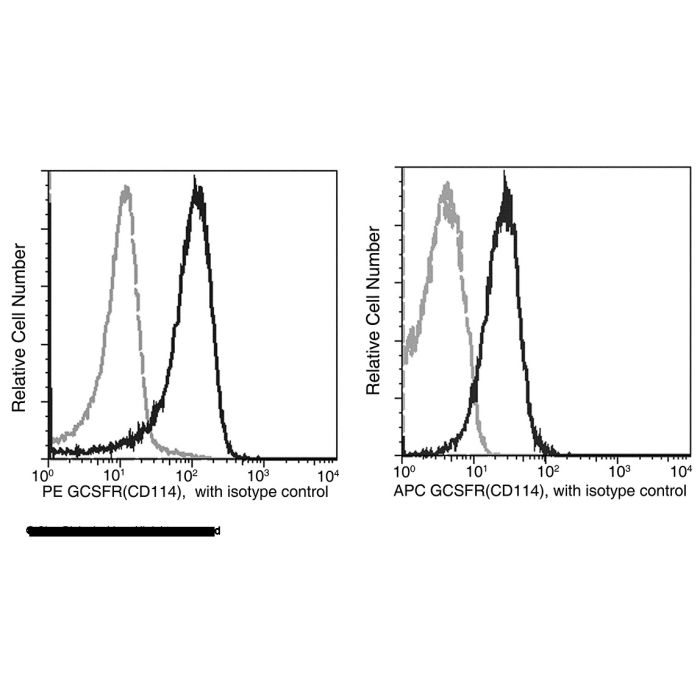
Flow cytometric analysis of anti-human GCSFR (CD114) on human whole blood granulocytes. The fluorescence histograms were derived from events with the forward and side light-scatter characteristics of viable granulocytes.
Image 1 Alt Text
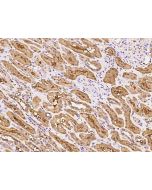
Human G-CSF R/CD114/CSF3R Flow Cytometry (FC) 5167
Granulocyte Colony Stimulating Factor Receptor (G-CSFR), also known as CD114, which belongs to the cytokine receptor superfamily, is a cell surface receptor for colony stimulating factor 3 (CSF3). It is a critical regulator of granulopoiesis. This type I membrane protein has a composite structure consisting of an immunoglobulin(Ig)-like domain, a cytokine receptor-homologous (CRH) domain and three fibronectin type III (FNIII) domains in the extracellular region. Mutations in the G-CSF receptor leading to carboxy-terminal truncation transduce hyperproliferative growth responses, and are implicated in the pathological progression of severe congenital neutropenia (SCN) to acute myelogenous leukemia (AML). Additionally, autocrine/paracrine stimulation of G-CSFR may be important in the biology of solid tumors, including metastasis.
Related Pathways
AKT Signaling Pathway
Jak-Stat Signaling Pathway
Autophagy Pathway
References
Kasper B, et al. (1999) Association of src-kinase Lyn and non-src-kinase Syk with the granulocyte colony-stimulating factor receptor (G-CSFR) is not abrogated in neutrophils from severe congenital neutropenia patients with point mutations in the G-CSFR mRNA. Int J Hematol. 70(4): 241-7.
Hollenstein U, et al. (2000) Endotoxin down-modulates granulocyte colony-stimulating factor receptor (CD114) on human neutrophils. J Infect Dis. 182(1): 343-6.
Kindwall-Keller TL, et al. (2008) Role of the proteasome in modulating native G-CSFR expression. Cytokine. 43(2): 114-23.
Beel K, et al. (2009) G-CSF receptor (CSF3R) mutations in X-linked neutropenia evolving to acute myeloid leukemia or myelodysplasia. Haematologica. 94(10): 1449-52.


-MM06-PE-APC-Granulocytes.png)