A synthetic peptide corresponding to the C-terminus of the Human CCND3
Preparation
Produced in rabbits immunized with a synthetic peptide corresponding to the C-terminus of the Human CCND3, and purified by antigen affinity chromatography.
Source
Polyclonal Rabbit IgG
Purification
Protein A & Antigen Affinity
Formulation
0.2 μm filtered solution in PBS
Conjugate
Unconjugated
Form
Liquid
Shipping
This antibody is shipped as liquid solution at ambient temperature. Upon receipt, store it immediately at the temperature recommended below.
Storage
This antibody can be stored at 2℃-8℃ for one month without detectable loss of activity. Antibody products are stable for twelve months from date of receipt when stored at -20℃ to -80℃. Preservative-Free. Avoid repeated freeze-thaw cycles.
Image / Experimental Information
Image 1 Description
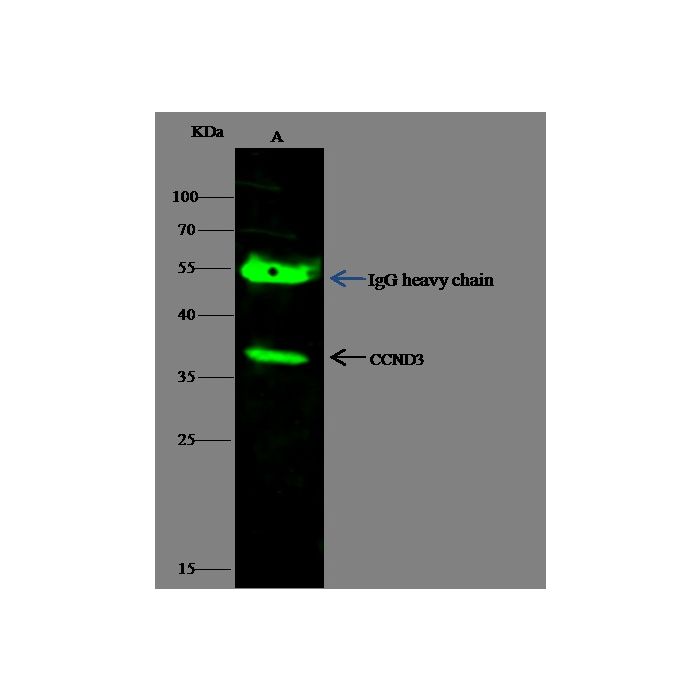
CCND3 was immunoprecipitated using: Lane A:0.5 mg Jurkat Whole Cell Lysate 4 µL anti-CCND3 rabbit polyclonal antibody and 60 μg of Immunomagnetic beads Protein G. Primary antibody: Anti-CCND3 rabbit polyclonal antibody,at 1:100 dilution Secondary antibody: Dylight 800-labeled antibody to rabbit IgG (H+L), at 1:5000 dilution Developed using the odssey technique. Performed under reducing conditions. Predicted band size: 35 kDa Observed band size: 36 kDa
Image 1 Alt Text
Human cyclin D3/CCND3 Immunoprecipitation(IP) 6141
CCND3 was immunoprecipitated using: Lane A:0.5 mg Jurkat Whole Cell Lysate 4 µL anti-CCND3 rabbit polyclonal antibody and 60 μg of Immunomagnetic beads Protein G. Primary antibody: Anti-CCND3 rabbit polyclonal antibody,at 1:100 dilution Secondary antibody: Dylight 800-labeled antibody to rabbit IgG (H+L), at 1:5000 dilution Developed using the odssey technique. Performed under reducing conditions. Predicted band size: 35 kDa Observed band size: 36 kDa
miR-212 exerts growth-suppressive effects in ATL cells largely by targeting CCND3 and may have therapeutic potential in ATL. CyclinD3 (CCND3) plays an important role in B-cell proliferation, development, and differentiation. MiR-592 can regulate CCND3 and function as a tumor suppressor in CRC. CCND3 gene amplification is a marker of aggressiveness and might be a predictor of tumor progression in bladder urothelial carcinoma.



-HD09MY1808-IP.png)
-HD09MY1808-WB.png)