Recombinant Human Cyclin E/CCNE1 Protein (Catalog#10902-H07B)
Preparation
This product is a recombinant monoclonal antibody expressed from HEK293 cells.
Source
Monoclonal Mouse IgG2b Clone #03
Purification
Protein A
Formulation
0.2 μm filtered solution in PBS
Conjugate
Unconjugated
Form
Liquid
Shipping
This antibody is shipped as liquid solution at ambient temperature. Upon receipt, store it immediately at the temperature recommended below.
Storage
This antibody can be stored at 2℃-8℃ for one month without detectable loss of activity. Antibody products are stable for twelve months from date of receipt when stored at -20℃ to -80℃. Preservative-Free. Avoid repeated freeze-thaw cycles.
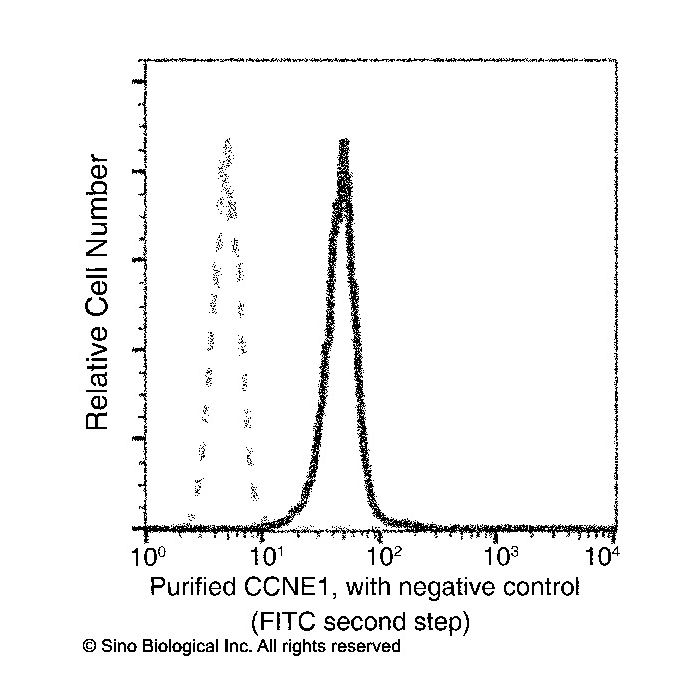
Flow cytometric analysis of Human CCNE1 expression on HeLa cells. The cells were treated according to manufacturer’s manual (BD Pharmingen™ Cat. No. 554714), stained with purified anti-Human CCNE1, then a FITC-conjugated second step antibody. The fluorescence histograms were derived from gated events with the forward and side light-scatter characteristics of intact cells.
Flow cytometric analysis of Human CCNE1 expression on HeLa cells. The cells were treated according to manufacturer’s manual (BD Pharmingen™ Cat. No. 554714), stained with purified anti-Human CCNE1, then a FITC-conjugated second step antibody. The fluorescence histograms were derived from gated events with the forward and side light-scatter characteristics of intact cells.
Cyclin E1 is a member of the highly conserved cyclin family and belongs to the E-type cyclin that functions as a regulator of S phase entry and progression in mammalian cells. Cyclin E1 serves as regulatory subunits that bind, activate, and provide substrate for its associated cyclin-dependent kinase2 (CDK2), whose activity is essential for cell cycle G1 / S transition. Over expression of this encoding gene has been found in many tumors, which results in chromosome instability and by extension, induce tumorigenesis. This protein was also found to associate with, and be involved in, the phosphorylation of NPAT protein (nuclear protein mapped to the ATM locus), which participates in cell-cycle regulated histone gene expression and plays a critical role in promoting cell-cycle progression in the absence of pRB. In general, cyclin E1, as an activator of phospho-CDK2 (pCDK2), is important for cell cycle progression and is frequently overexpressed in cancer cells.
Related Pathways
p53 Pathway
References
Honda R, et al. (2005) The structure of cyclin E1 / CDK2: implications for CDK2 activation and CDK2-independent roles. The EMBO Journal. 24: 452-63.
Geng Y, et al. (2007) Kinase-Independent Function of Cyclin E. 25(1): 127-39.