Produced in rabbits immunized with E. coli-derived Human Bad fragment, and purified by antigen affinity chromatography.
Source
Polyclonal Rabbit IgG
Purification
Protein A & Antigen Affinity
Formulation
PBS, pH7.0 with 0.03% Proclin300
Conjugate
Unconjugated
Form
Liquid
Shipping
This antibody is shipped as liquid solution at ambient temperature. Upon receipt, store it immediately at the temperature recommended below.
Storage
This antibody can be stored at 2℃-8℃ for one month without detectable loss of activity. Antibody products are stable for twelve months from date of receipt when stored at -20℃ to -80℃. Avoid repeated freeze-thaw cycles.
Bcl-2 agonist of cell death (BAD) is a BH3-only member of the Bcl-2 family which possesses important regulatory function in apoptosis. BAD has also been shown to possess many non-apoptotic functions closely linked to cancer including regulation of glycolysis, autophagy, cell cycle progression and immune system development. Oral squamous cell carcinoma (OSCC) is a type of cancer with high morbidity and mortality rates worldwide; it also demonstrates chemotherapeutic resistance. Triterpenoid ursolic acid has been shown to exhibit various biological activities and anticancer effects in several preclinical studies. The apoptosis‑associated signaling showed that ursolic acid decreased the phosphorylation of AKT (Ser473) and B‑cell lymphoma 2 (Bcl‑2)‑associated agonist of cell death (BAD; Ser136), and the protein levels of Bcl‑2 and Bcl‑extra large (Bcl‑xL), and increased the expression of BAD and Bcl‑2‑associated X (Bax) protein in CAR cells.

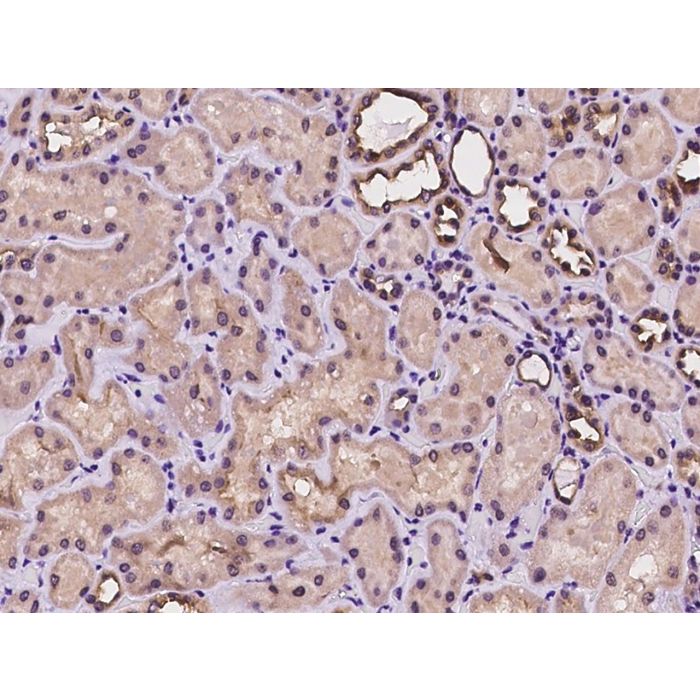
-HD12OC0875-500-human-kidney-IHC-P.png)
-HD12OC0875-200-A431-IF.png)