Recombinant Human Cadherin-1 / CDH1 / CD324 / E-cadherin protein (Catalog#10204-H08H)
Preparation
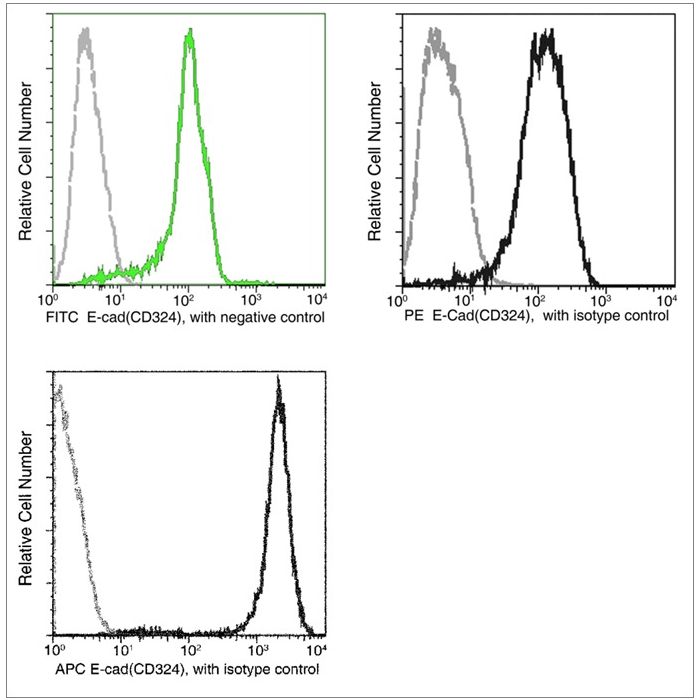
This antibody was produced from a hybridoma resulting from the fusion of a mouse myeloma with B cells obtained from a mouse immunized with purified, recombinant Human Cadherin-1 / CDH1 / CD324 / E-cadherin (rh Cadherin-1 / CDH1 / CD324 / E-cadherin; Catalog#10204-H08H; NP_004351.1; Met 1-Ile 707) and conjugated with PE under optimum conditions, the unreacted PE was removed.
Source
Monoclonal Mouse IgG2a Clone #08
Purification
Protein A
Formulation
PBS solution containing 0.5% BSA and 0.09% sodium azide
Concentration
5 μl/Test, 0.1 mg/ml
Conjugate
PE
Form
Liquid
Shipping
This antibody is shipped as liquid solution at ambient temperature. Upon receipt, store it immediately at the temperature recommended below.
Storage
This antibody can be stored at 2℃-8℃ for twelve months without detectable loss of activity. Protected from prolonged exposure to light. Do not freeze ! Sodium azide is toxic to cells and should be disposed of properly. Flush with large volumes of water during disposal.
Cadherins are calcium-dependent cell adhesion proteins which preferentially interact with themselves in a homophilic manner in connecting cells, and thus may contribute to the sorting of heterogeneous cell type. E-cadherin (E-Cad), also known as CDH1 and CD324, is a calcium-dependent cell adhesion molecule the intact function of which is crucial for the establishment and maintenance of epithelial tissue polarity and structural integrity. Mutations in CDH1 occur in diffuse type gastric cancer, lobular breast cancer, and endometrial cancer. In human cancers, partial or complete loss of E-cadherin expression correlates with malignancy. During apoptosis or with calcium influx, E-Cad is cleaved by the metalloproteinase to produce fragments of about 38 kDa (E-CAD/CTF1), 33 kDa (E-CAD/CTF2) and 29 kDa (E-CAD/CTF3), respectively. E-Cad has been identified as a potent invasive suppressor, as downregulation of E-cadherin expression is involved in dysfunction of the cell-cell adhesion system, and often correlates with strong invasive potential and poor prognosis of human carcinomas.
Research Areas
Hemangioblast Markers
Tumor Suppressors
Related Pathways
Canonical Wnt Pathway
EGFR Signaling Pathway
References
Wang HD, et al. (2004) CDH1 germline mutation in hereditary gastric carcinoma. World J Gastroenterol. 10(21): 3088-93.
Masterson J, et al. (2007) Posttranslational truncation of E-cadherin and significance for tumour progression. Cells Tissues Organs. 185(1-3): 175-9.
Mrgineanu E, et al. (2008) Correlation between E-cadherin abnormal expressions in different types of cancer and the process of metastasis. Rev Med Chir Soc Med Nat Iasi. 112(2): 432-6.


-MM08-FITC-PE-APC-MCF-7.png)
