EGF / Epidermal Growth Factor Neutralizing Antibody sinobiological 10605-R001

$286.00
In stock
SKU
10605-R001
Catalog No.SizePrice (USD)
10605-R001-200200 µg$296.22
10605-R001-500500 µg$444.33

General Information

Product nameEGF / Epidermal Growth Factor Neutralizing Antibody
Validated applicationsNeutralization
Species reactivityReacts with: Human
SpecificityHuman EGF Has cross-reactivity in ELISA with Canine EGF (Catalog # 170013-D07E) Mouse EGF (Catalog # 50482-MNCH)
ImmunogenRecombinant Human EGF / Epidermal Growth Factor Protein (Catalog#10605-HNAE)
PreparationThis antibody was obtained from a rabbit immunized with purified, recombinant Human EGF / Epidermal Growth Factor (rh EGF / Epidermal Growth Factor; Catalog#10605-HNAE; NP_001954.2; Asn971-Arg1023) and was produced using recombinant antibody technology.
SourceMonoclonal Rabbit IgG Clone #R001
PurificationProtein A
Formulation0.2 μm filtered solution in Histidine and Arginine buffer containing 120mM NaCl, 0.02% Tween 80, pH6.0
ConjugateUnconjugated
Endotoxin< 3 EU/mg
FormLiquid
ShippingThis antibody is shipped as liquid solution at ambient temperature. Upon receipt, store it immediately at the temperature recommended below.
StorageThis antibody can be stored at 2℃-8℃ for one month without detectable loss of activity. Antibody products are stable for twelve months from date of receipt when stored at -20℃ to -80℃. Preservative-Free. Avoid repeated freeze-thaw cycles.

Synonyms: Anti-HOMG4 Antibody; Anti-URG Antibody

Image / Experimental Information

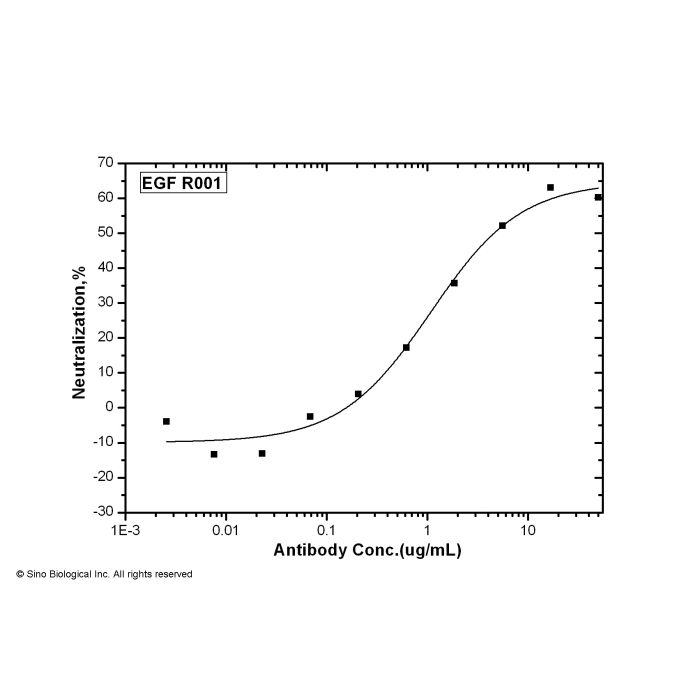
Image 1 DescriptionCell Proliferation Induced by EGF was Neutralized by Human EGF Antibody. Recombinant Human EGF stimulates proliferation in the Balb/c 3T3 mouse embryonic fibroblast cell line. Proliferation elicited by Recombinant Human EGF (2 ng/mL) is neutralized by increasing concentrations of Human EGF Monoclonal Antibody (Catalog # 10605-R001). The IC50 is typically 2.5-7.5 μg/mL.
Image 1 Alt TextHuman Epidermal Growth Factor/EGF Blocking/Neutralization (B/N) 5601
Image 1 URLSource image

Background Information

Full Nameepidermal growth factor
DescriptionEGF is the founding member of the EGF-family of proteins. Members of this protein family have highly similar structural and functional characteristics. EGF contains 9 EGF-like domains and 9 LDL-receptor class B repeats. Human EGF is a 6045-Da protein with 53 amino acid residues and three intramolecular disulfide bonds. As a low-molecular-weight polypeptide, EGF was first purified from the mouse submandibular gland, but since then it was found in many human tissues including submandibular gland, parotid gland. It can also be found in human platelets, macrophages, urine, saliva, milk, and plasma. EGF is a growth factor that stimulates the growth of various epidermal and epithelial tissues in vivo and in vitro and of some fibroblasts in cell culture. It results in cellular proliferation, differentiation, and survival. Salivary EGF, which seems also regulated by dietary inorganic iodine, also plays an important physiological role in the maintenance of oro-esophageal and gastric tissue integrity. EGF acts by binding with high affinity to epidermal growth factor receptor on the cell surface and stimulating the intrinsic protein-tyrosine kinase activity of the receptor. The tyrosine kinase activity, in turn, initiates a signal transduction cascade that results in a variety of biochemical changes within the cell - a rise in intracellular calcium levels, increased glycolysis and protein synthesis, and increases in the expression of certain genes including the gene for EGFR - that ultimately lead to DNA synthesis and cell proliferation.
Related Pathways
  • EGFR Signaling Pathway
  • Jak-Stat Signaling Pathway
References
  1. Chen JX, et al. (2011) Involvement of c-Src/STAT3 signal in EGF-induced proliferation of rat spermatogonial stem cells. Mol Cell Biochem. 358(1-2):67-73.
  2. Guo Y, et al. (2012) Correlations among ERCC1, XPB, UBE2I, EGF, TAL2 and ILF3 revealed by gene signatures of histological subtypes of patients with epithelial ovarian cancer. Oncol Rep. 27(1):286-92.
  3. Kim S, et al. (2012) Smad7 acts as a negative regulator of the epidermal growth factor (EGF) signaling pathway in breast cancer cells. Cancer Lett. 314(2):147-54.
  4. Chatterton RT Jr, et al. (2010) Breast ductal lavage for assessment of breast cancer biomarkers. Horm Cancer. 1(4):197-204.

title: RIZ2 at the crossroad of the EGF/EGFR signaling in colorectal cancer
authors: Marzia Di Donato; Erika Di Zazzo; ...; Ciro Abbondanza
journal: Journal of Translational Medicine
date: 2023-10-18
pmid: 37853459
pmcid: 10585774
cited_by_count: 6
techniques: Cell Culture; Concentration Assay; Enzyme-linked Immunosorbent Assay; Immunofluorescence; Microscopy; Migration; Software; Staining; Transfection; Western Blot
bioz_score: 91

title: Cooperative regulation of adherens junction expansion through epidermal growth factor receptor activation.
authors: Chaoyu Fu; Aditya Arora; ...; Virgile Viasnoff
journal: Journal of cell science
date: 2022-03-08
pmid: 35099018
doi: 10.1242/jcs.258929
cited_by_count: 5
techniques: Control; Recombinant; Western Blot
bioz_score: 91

title: Analysis of Molecular Cargos in Single Extracellular Vesicle for Identification of Disease-Relevant Vesicles as Liquid Biopsy Markers
authors: Guo, Kaizhu
date: 2021-01-01
cited_by_count: 0
bioz_score: 91

title: Modulation of hepatitis B virus infection by epidermal growth factor secreted from liver sinusoidal endothelial cells
authors: Shin-Wei Chen; Misao Himeno; ...; Taketomo Kido
journal: Scientific Reports
date: 2020-09-01
pmid: 32873852
doi: 10.1038/s41598-020-71453-5
pmcid: 7462976
cited_by_count: 17
techniques: Blocking Assay; Immunofluorescence; Incubation; Inhibition; Negative Control; Staining; Western Blot
bioz_score: 91

Reviews

Write Your Own Review
You're reviewing:EGF / Epidermal Growth Factor Neutralizing Antibody sinobiological 10605-R001
Your Rating
Copyright © 2025 Biogege, Inc. All rights reserved.