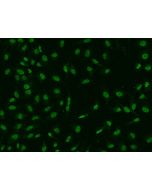
Recombinant Human ENPP5 protein (Catalog#11519-H08H)
Preparation
Produced in rabbits immunized with purified, recombinant Human ENPP5 (rh ENPP5; Catalog#11519-H08H; Q9UJA9; Met1-Gly429). Total IgG was purified by Protein A affinity chromatography.
Source
Polyclonal Rabbit IgG
Purification
Protein A
Formulation
0.2 μm filtered solution in PBS
Conjugate
Unconjugated
Form
Liquid
Shipping
This antibody is shipped as liquid solution at ambient temperature. Upon receipt, store it immediately at the temperature recommended below.
Storage
This antibody can be stored at 2℃-8℃ for one month without detectable loss of activity. Antibody products are stable for twelve months from date of receipt when stored at -20℃ to -80℃. Preservative-Free. Avoid repeated freeze-thaw cycles.
ENPP5 is a member of the nucleotide pyrophosphatase/phosphodiesterase family (NPP). It is a family comprised of dimeric enzymes that catalyze the hydrolysis of phosphate diester bonds. There are seven isoforms in NPP family, some of which prefer nucleotide substrates, some of which prefer phospholipid substrates, and others of which prefer substrates that have not yet been determined. NPP also belongs to the alkaline phosphatase (AP) superfamily of enzymes and they are located in the cell membrane and hydrolyze extracellular phosphate diesters to affect a wide variety of biological processes. ENPP5 belongs to a group of nucleotidemetabolizing ectoenzymes, which regulate the availability of extracellular nucleotides. ENPP5 may play a role in neuronal cell communication. However, it lacks nucleotide pyrophosphatase and lysopholipase D activity. It may also be involved in neuronal cell communication. The amino acid sequence of human ENPP5 is 100%, 88%, and 82% identical to that of chimpanzee, dog and mouse/rat. ENPP5 functions in phospholipid metabolism.
Research Areas
Phosphatases and Regulators
References
Strausberg RL, et al. (2002) Generation and initial analysis of more than 15,000 full-length human and mouse cDNA sequences. Proc Natl Acad Sci. 99(26):16899-903.
Gerhard DS, et al. (2004) The status, quality, and expansion of the NIH full-length cDNA project: the Mammalian Gene Collection (MGC). Genome Res. 14(10B):2121-7.
Lamesch P, et al. (2007) hORFeome v3.1: a resource of human open reading frames representing over 10,000 human genes. Genomics. 89(3):307-15.