Recombinant Human Fgf8 Protein (Catalog#16124-HNAE)
Preparation
Produced in rabbits immunized with purified, recombinant Human Fgf8 (rh Fgf8; Catalog#16124-HNAE; NP_149355.1; Gln23-Arg204). Fgf8 specific IgG was purified by Human Fgf8 affinity chromatography.
Source
Polyclonal Rabbit IgG
Purification
Protein A & Antigen Affinity
Formulation
0.2 μm filtered solution in PBS
Conjugate
Unconjugated
Form
Liquid
Shipping
This antibody is shipped as liquid solution at ambient temperature. Upon receipt, store it immediately at the temperature recommended below.
Storage
This antibody can be stored at 2℃-8℃ for one month without detectable loss of activity. Antibody products are stable for twelve months from date of receipt when stored at -20℃ to -80℃. Preservative-Free. Avoid repeated freeze-thaw cycles.
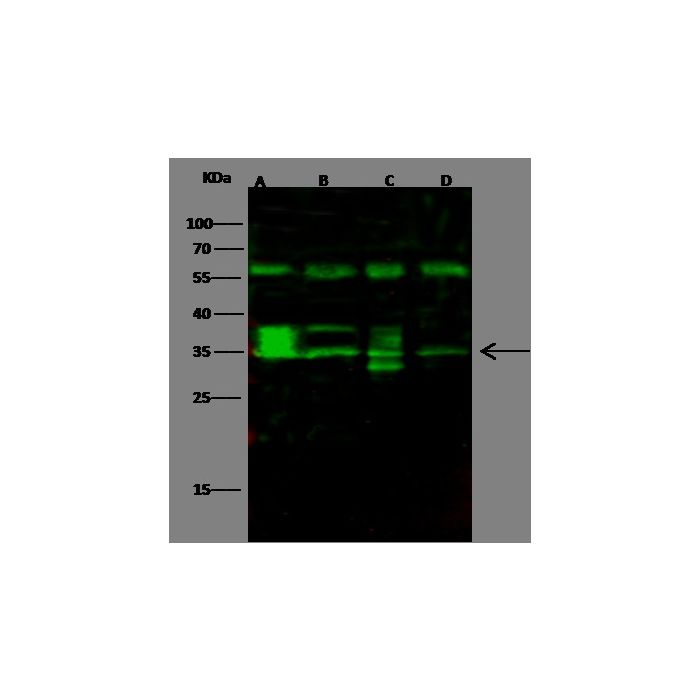
Anti-FGF8a rabbit polyclonal antibody at 1:500 dilution Lane A: HepG2 Whole Cell Lysate Lane B: Jurkat Whole Cell Lysate Lane C: Hela Whole Cell Lysate Lane D: NIH3T3 Whole Cell Lysate Lysates/proteins at 30 μg per lane. Secondary Goat Anti-Rabbit IgG H&L (Dylight800) at 1/10000 dilution. Developed using the Odyssey technique. Performed under reducing conditions. Predicted band size:27 kDa Observed band size:35 kDa (We are unsure as to the identity of these extra bands.)
In mammalian embryos, transient Fgf8 expression defines the developing isthmic region, lying between the midbrain and the first rhombomere, but there has been uncertainty about the existence of a distinct isthmic segment in postnatal mammals. Retinoic acid (RA) directly represses Fgf8 through a RARE-mediated mechanism that promotes repressive chromatin, thus providing valuable insight into the mechanism of RA-FGF antagonism during progenitor cell differentiation. Fgf8 encodes a key signaling factor, and its precise regulation is essential for embryo patterning.


-HD09JA2811-WB.png)