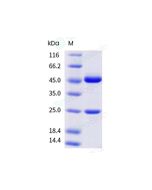
Human FGFR2 No cross-reactivity in ELISA with Human FGFR1 / CD331 Human FGFR4 / CD334
Immunogen
Recombinant Human FGFR2 protein (Catalog#10824-H08H)
Preparation
This antibody was obtained from a rabbit immunized with purified, recombinant Human FGFR2 extracellular domain (rh FGFR2; Catalog#10824-H08H; NP_000132.3; Met 1-Glu 377).
Source
Monoclonal Rabbit IgG Clone #016
Purification
Protein A
Formulation
0.2 μm filtered solution in PBS
Conjugate
Unconjugated
Form
Liquid
Shipping
This antibody is shipped as liquid solution at ambient temperature. Upon receipt, store it immediately at the temperature recommended below.
Storage
This antibody can be stored at 2℃-8℃ for one month without detectable loss of activity. Antibody products are stable for twelve months from date of receipt when stored at -20℃ to -80℃. Preservative-Free. Avoid repeated freeze-thaw cycles.
FGFR2, also known as CD332, belongs to the fibroblast growth factor receptor subfamily where amino acid sequence is highly conserved between members and throughout evolution. FGFR2 acts as cell-surface receptor for fibroblast growth factors and plays an essential role in the regulation of cell proliferation, differentiation, migration and apoptosis, and in the regulation of embryonic development. It is required for normal embryonic patterning, trophoblast function, limb bud development, lung morphogenesis, osteogenesis and skin development. FGFR2 plays an essential role in the regulation of osteoblast differentiation, proliferation and apoptosis, and is required for normal skeleton development. It also promotes cell proliferation in keratinocytes and imature osteoblasts, but promotes apoptosis in differentiated osteoblasts. FGFR2 signaling is down-regulated by ubiquitination, internalization and degradation. Mutations that lead to constitutive kinase activation or impair normal CD332 maturation, internalization and degradation lead to aberrant signaling. Over-expressed FGFR2 promotes activation of STAT1. Defects in CD3322 are the cause of Crouzon syndrome, Jackson-Weiss syndrome, Apert syndrome, Pfeiffer syndrome, Beare-Stevenson cutis gyrata syndrome, familial scaphocephaly syndrome, lacrimo-auriculo-dento-digital syndrome and Antley-Bixler syndrome without genital anomalies or disordered steroidogenesis.
Research Areas
Receptor Tyrosine Kinases (RTKs)
Cancer Drug Targets
Tags
Cancer Immunotherapy
Immune Checkpoint
Immunotherapy
Targeted Therapy
References
Marie PJ, et al. (2003) Regulation of human cranial osteoblast phenotype by FGF-2, FGFR-2 and BMP-2 signaling. Histol. 17(3):877-85.
Park WJ, et al. (1996) Novel FGFR2 mutations in Crouzon and Jackson-Weiss syndromes show allelic heterogeneity and phenotypic variability. Hum Mol Genet. 4(7):1229-33.
Orr-Urtreger A, et al. (1993) Developmental localization of the splicing alternatives of fibroblast growth factor receptor-2 (FGFR2). Dev Biol. 158(2):475-86.