Human FH/Fumarate Hydratase No cross-reactivity in ELISA with E.coli cell lysate
Immunogen
Recombinant Human Fumarate Hydratase / FH protein (Catalog#12115-H08E)
Preparation
This antibody was produced from a hybridoma resulting from the fusion of a mouse myeloma with B cells obtained from a mouse immunized with purified, recombinant Human Fumarate Hydratase / FH (rh Fumarate Hydratase / FH; Catalog#12115-H08E; P07954-1; Ala 45-Lys 510). The IgG fraction of the cell culture supernatant was purified by Protein A affinity chromatography.
Source
Monoclonal Mouse IgG1 Clone #3D5A3G7
Purification
Protein A
Formulation
0.2 μm filtered solution in PBS
Conjugate
Unconjugated
Form
Liquid
Shipping
This antibody is shipped as liquid solution at ambient temperature. Upon receipt, store it immediately at the temperature recommended below.
Storage
This antibody can be stored at 2℃-8℃ for one month without detectable loss of activity. Antibody products are stable for twelve months from date of receipt when stored at -20℃ to -80℃. Preservative-Free. Avoid repeated freeze-thaw cycles.
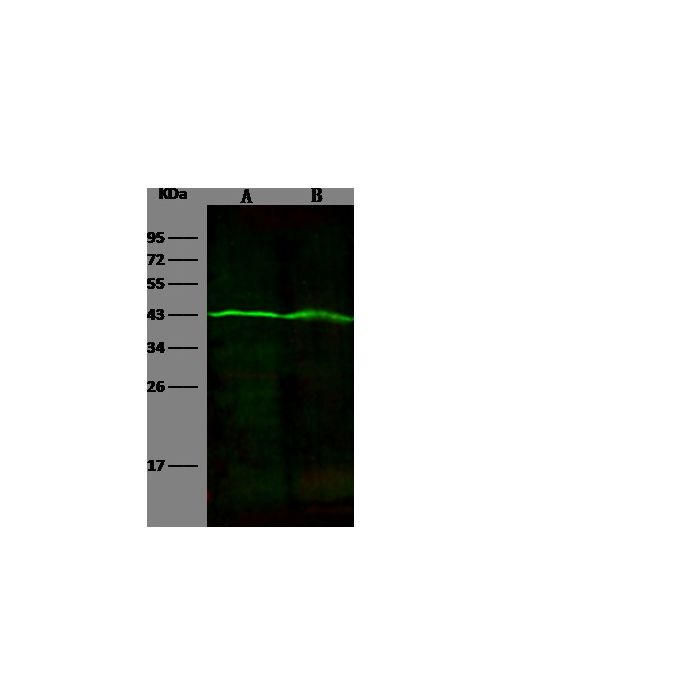
Anti-FH mouse monoclonal antibody at 1:500 dilution Lane A: Hela Whole Cell Lysate Lane B: 293T Whole Cell Lysate Lysates/proteins at 30 μg per lane. Secondary Goat Anti-Mouse IgG H&L (Dylight800) at 1/15000 dilution. Developed using the Odyssey technique. Performed under reducing conditions. Predicted band size:55 kDa Observed band size:47 kDa
Fumarate Hydratase (FH) is an enzymatic component of the tricarboxylic acid (TCA) cycle, or Krebs cycle, and catalyzes the formation of L-malate from fumarate. It exists in both a cytosolic form and an N-terminal extended form, differing only in the translation start site used. The N-terminal extended form is targeted to the mitochondrion, where the removal of the extension generates the same form as in the cytoplasm. Fumarate Hydratase is similar to some thermostable class II fumarases and functions as a homotetramer. Mutations in this gene can cause fumarase deficiency and lead to progressive encephalopathy. Individuals with hemizygous germline fumarate hydratase (FH) mutations are predisposed to renal cancer. These tumors predominantly exhibit functional inactivation of the remaining wild-type allele, implicating FH inactivation as a tumor-promoting event.
References
King A, et al. (2005) Succinate dehydrogenase and fumarate hydratase: linking mitochondrial dysfunction and cancer. Oncogene. 25(34): 4675-82.
Alam NA, et al. (2003) Genetic and functional analyses of FH mutations in multiple cutaneous and uterine leiomyomatosis, hereditary leiomyomatosis and renal cancer, and fumarate hydratase deficiency. Hum Mol Genet.12(11): 1241-52.
Pollard PJ, et al. (2003) The TCA cycle and tumorigenesis: the examples of fumarate hydratase and succinate dehydrogenase. Ann Med. 35(8): 632-9.