Recombinant Human ficolin 1/FCN1/FCNA protein (Catalog#10930-H08H)
Preparation
This antibody was produced from a hybridoma resulting from the fusion of a mouse myeloma with B cells obtained from a mouse immunized with purified, recombinant Human ficolin 1/FCN1/FCNA (rh ficolin 1/FCN1/FCNA; Catalog#10930-H08H; NP_001994.2; Met1-Ala326). The IgG fraction of the cell culture supernatant was purified by Protein A affinity chromatography.
Source
Monoclonal Mouse IgG1 Clone #08
Purification
Protein A
Formulation
0.2 μm filtered solution in PBS
Conjugate
Unconjugated
Form
Liquid
Shipping
This antibody is shipped as liquid solution at ambient temperature. Upon receipt, store it immediately at the temperature recommended below.
Storage
This antibody can be stored at 2℃-8℃ for one month without detectable loss of activity. Antibody products are stable for twelve months from date of receipt when stored at -20℃ to -80℃. Preservative-Free. Avoid repeated freeze-thaw cycles.
Synonyms: Anti-FCNM Antibody
Image / Experimental Information
Image 1 Description
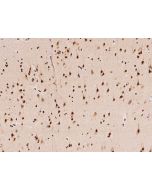
Immunochemical staining of human FCN1 in human spleen with mouse monoclonal antibody (1:60, formalin-fixed paraffin embedded sections).
Ficolins are humoral molecules of the innate immune systems which recognize carbohydrate molecules on pathogens, apoptotic and necrotic cells. The Ficolin family of proteins are characterized by the presence of a leader peptide, a short N-terminal segment, followed by a collagen-like region, and a C-terminal fibrinogen-like domain. Ficolins are humoral molecules of the innate immune systems which recognize carbohydrate molecules on pathogens, apoptotic and necrotic cells. Three Ficolins have been identified in humans: L-Ficolin, H-Ficolin and M-Ficolin (also referred to as Ficolin-2, -3 and -1, respectively). They are soluble oligomeric defence proteins with lectin-like activity and they are structurally similar to the human collectins, mannan-binding lectin (MBL) and surfactant protein A and D. Dysfunction or abnormal expressions of Ficolins may involved in the pathogenesis of human diseases including infectious and inflammatory diseases, autoimmune disease and clinical syndrome of preeclampsia. They are soluble oligomeric defence proteins with lectin-like activity and they are structurally similar to the human collectins, mannan-binding lectin (MBL) and surfactant protein A and D. Upon recognition of the infectious agent, the Ficolins act through two distinct routes: initiate the lectin pathway of complement activation through attached serine proteases (MASPs), and a primitive opsonophagocytosis thus limiting the infection and concurrently orchestrating the subsequent adaptive clonal immune response. Ficolin-1 (FCN1) is predominantly expressed in the peripheral blood leukocytes.
References
Thiel S. (2007) Complement activating soluble pattern recognition molecules with collagen-like regions, mannan-binding lectin, ficolins and associated proteins. Mol Immunol. 44(16): 3875-88.
Zhang XL, et al. (2008) Ficolins: structure, function and associated diseases. Adv Exp Med Biol. 632: 105-15.
Garred P, et al. (2009) MBL2, FCN1, FCN2 and FCN3-The genes behind the initiation of the lectin pathway of complement. Mol Immunol. 46(14): 2737-44.
title: Establishing a Case for Anti-complement Therapy in Membranous Nephropathy authors: Isabelle Ayoub; John P. Shapiro; ...; Brad H. Rovin journal: Kidney International Reports date: 2020-12-13 pmid: 33615073 doi: 10.1016/j.ekir.2020.11.032 pmcid: 7879111 cited_by_count: 17 bioz_score: 90