A synthetic peptide corresponding to the center region of the Human FOXJ1
Preparation
Produced in rabbits immunized with a synthetic peptide corresponding to the center region of the Human FOXJ1, and purified by antigen affinity chromatography.
Source
Polyclonal Rabbit IgG
Purification
Protein A & Antigen Affinity
Formulation
0.2 μm filtered solution in PBS
Conjugate
Unconjugated
Form
Liquid
Shipping
This antibody is shipped as liquid solution at ambient temperature. Upon receipt, store it immediately at the temperature recommended below.
Storage
This antibody can be stored at 2℃-8℃ for one month without detectable loss of activity. Antibody products are stable for twelve months from date of receipt when stored at -20℃ to -80℃. Preservative-Free. Avoid repeated freeze-thaw cycles.
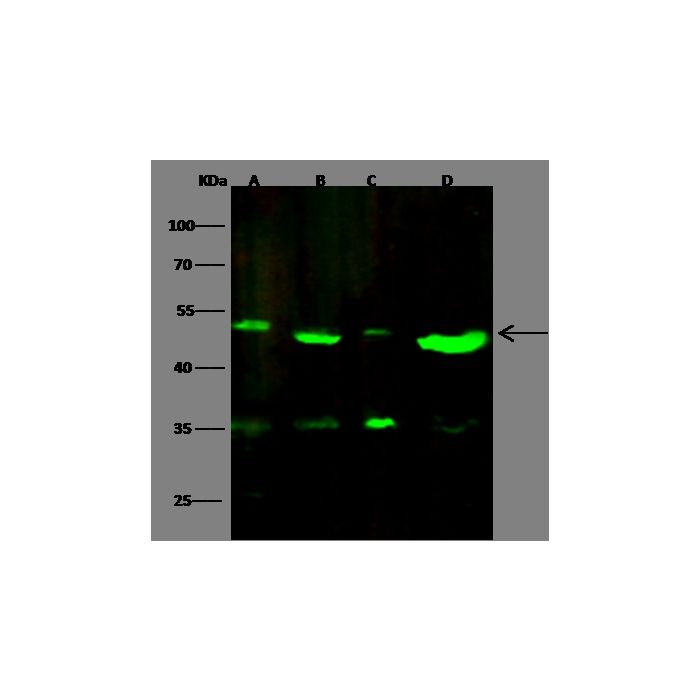
Anti-FOXJ1 rabbit polyclonal antibody at 1:500 dilution Lane A: A549 Whole Cell Lysate Lane B: HepG2 Whole Cell Lysate Lane C: Hela Whole Cell Lysate Lane D: MCF7 Whole Cell Lysate Lysates/proteins at 30 μg per lane. Secondary Goat Anti- Rabbit IgG H&L (Dylight 800) at 1/10000 dilution. Developed using the Odyssey technique. Performed under reducing conditions. Predicted band size:45 kDa Observed band size:50 kDa (We are unsure as to the identity of these extra bands.)
FOXJ1 is a member of the Forkhead/winged-helix (Fox) family of transcription factors, which is required for the differentiation of the cells acting as adult neural stem cells that participate in neurogenesis and give rise to neurons, astrocytes, oligodendrocytes. Recent studies suggested that FOXJ1 may function as a tumor suppressor gene in breast cancer. Overexpression of FOXJ1 was also involved in tumor cell proliferation and cell-cycle progression in hepatocellular carcinoma (HCC) cell lines. Forkhead-box J1 (FOXJ1) is a presumed transcription factor that can suppress T cell activity, at least partially, through the repression of NFkappaB activity, dysregulation of FOXJ1 is thought to be associated with autoimmune diseases and/or other inflammatory diseases. Decreased FOXJ1 expression was significantly correlated with clinic stage, lymph node metastasis, and distant metastasis, and lower FOXJ1 expression independently predicted shorter survival time in gastric carcinoma. FOXJ1 may be an attractive therapeutic target for the treatment of gastric cancer.


-HD09AU2411-WB.png)