Recombinant Human FSTL1 protein (Catalog#10924-H08H)
Preparation
This antibody was obtained from a rabbit immunized with purified, recombinant Human FSTL1 (rh FSTL1; Catalog#10924-H08H; NP_009016.1; Met1-Ile308).
Source
Monoclonal Rabbit IgG Clone #009
Purification
Protein A
Formulation
0.2 μm filtered solution in PBS
Conjugate
Unconjugated
Form
Liquid
Shipping
This antibody is shipped as liquid solution at ambient temperature. Upon receipt, store it immediately at the temperature recommended below.
Storage
This antibody can be stored at 2℃-8℃ for one month without detectable loss of activity. Antibody products are stable for twelve months from date of receipt when stored at -20℃ to -80℃. Preservative-Free. Avoid repeated freeze-thaw cycles.
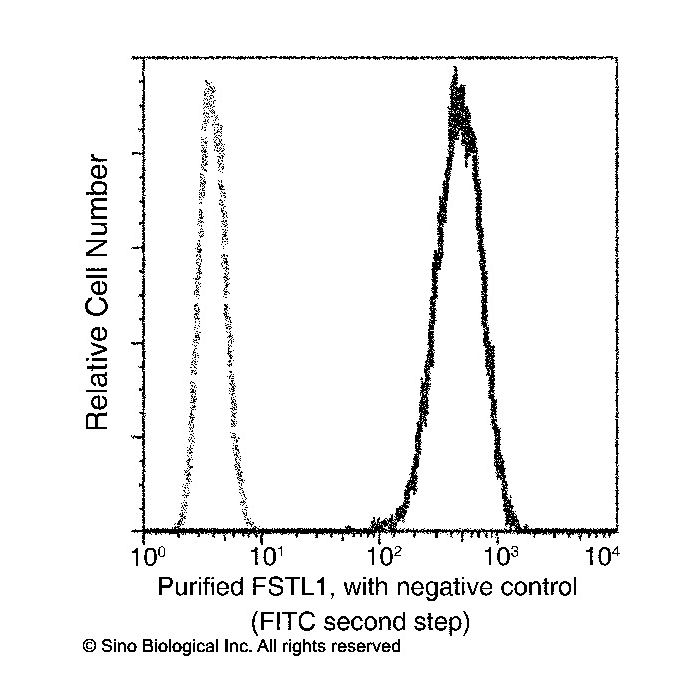
Flow cytometric analysis of Human FSTL1 expression on HeLa cells . The cells were treated according to manufacturer’s manual (BD Pharmingen™ Cat. No. 554714), stained with purified anti-Human FSTL1, then a FITC-conjugated second step antibody. The fluorescence histograms were derived from gated events with the forward and side light-scatter characteristics of intact cells.
Flow cytometric analysis of Human FSTL1 expression on HeLa cells . The cells were treated according to manufacturer’s manual (BD Pharmingen™ Cat. No. 554714), stained with purified anti-Human FSTL1, then a FITC-conjugated second step antibody. The fluorescence histograms were derived from gated events with the forward and side light-scatter characteristics of intact cells.
Follistatin-related protein 1 (FSTL1) is an extracellular glycoprotein whose functional significance in physiological and pathological processes is incompletely understood. Recently, we have shown that FSTL1 acts as a muscle-derived secreted factor that is up-regulated by Akt activation and ischemic stress and that FSTL1 exerts favorable actions on the heart and vasculature. Here, we sought to identify the receptor that mediates the cellular actions of FSTL1. It contains an FS module, a follistatin-like sequence containing 10 conserved cysteine residues. FSTL1 is thought to be an autoantigen associated with rheumatoid arthritis. DIP2A functions as a novel receptor that mediates the cardiovascular protective effects of FSTL1. Experiment results have provided in vivo and in vitro evidence to demonstrate that Fstl1 modulates lung development and alveolar maturation, in part, through BMP4 signaling.
References
Rosenberg MI, et al. (2006) MyoD inhibits Fstl1 and Utrn expression by inducing transcription of miR-206. J Cell Biol. 175(1): 77-85.
Ouchi N, et al. (2010) DIP2A functions as a FSTL1 receptor. J Biol Chem. 285(10): 7127-34.
Geng Y, et al. (2011) Follistatin-like 1 (Fstl1) is a bone morphogenetic protein (BMP) 4 signaling antagonist in controlling mouse lung development. Proc Natl Acad Sci U S A. 108(17): 7058-63.
title: Follistatin-like 1 protects endothelial function in the spontaneously hypertensive rat by inhibition of endoplasmic reticulum stress through AMPK-dependent mechanism. authors: Hanwen Liu; Yanwen Li; ...; Fang Pei journal: Clinical and experimental hypertension (New York, N.Y. : 1993) date: 2023-11-16 pmid: 37963199 doi: 10.1080/10641963.2023.2277654 cited_by_count: 5 techniques: Activation Assay; Ex Vivo; Fluorescence; Functional Assay; Incubation; Microscopy; Modification; Phospho-proteomics; Western Blot bioz_score: 91