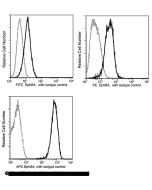
Human Galectin-1/LGALS1 No cross-reactivity in ELISA with Mouse Galectin1 Human Galectin3 Human Galectin8
Immunogen
Recombinant Human Galectin-1 protein (Catalog#10290-HNAE)
Preparation
This antibody was produced from a hybridoma resulting from the fusion of a mouse myeloma with B cells obtained from a mouse immunized with purified, recombinant Human Galectin-1 (rh Galectin-1; Catalog#10290-HNAE; NP_002296.1; Met1-Asp135). The IgG fraction of the cell culture supernatant was purified by Protein A affinity chromatography.
Source
Monoclonal Mouse IgG1 Clone #01
Purification
Protein A
Formulation
0.2 μm filtered solution in PBS
Conjugate
Unconjugated
Form
Liquid
Shipping
This antibody is shipped as liquid solution at ambient temperature. Upon receipt, store it immediately at the temperature recommended below.
Storage
This antibody can be stored at 2℃-8℃ for one month without detectable loss of activity. Antibody products are stable for twelve months from date of receipt when stored at -20℃ to -80℃. Preservative-Free. Avoid repeated freeze-thaw cycles.
Synonyms: Anti-GAL1 Antibody; Anti-GBP Antibody
Image / Experimental Information
Image 1 Description
Immunochemical staining of human Galectin1 in human placenta with mouse monoclonal antibody (1:60, formalin-fixed paraffin embedded sections).
Image 1 Alt Text
Human Galectin-1/LGALS1 Immunohistochemistry(IHC) 4170
Galectin-1 (Gal-1, GAL1), is a member of the galectins, a family of animal lectins ranging from Caenorhabditis elegans to humans, which is defined by their affinity for beta-galactosides and by significant sequence similarity in the carbohydrate-binding site. It is a homodimer with a subunit molecular mass of 14.5 kDa, which contains six cysteine residues per subunit. The cysteine residues should be in a free state to maintain a molecular structure that is capable of showing lectin activity. This endogenous lectin widely expressed at sites of inflammation and tumor growth has been postulated as an attractive immunosuppressive agent to restore immune cell tolerance and homeostasis in autoimmune and inflammatory settings. On the other hand, galectin-1 contributes to different steps of tumor progression including cell adhesion, migration, and tumor-immune escape, suggesting that blockade of galectin-1 might result in therapeutic benefits in cancer. Several potential glycoprotein ligands for galectin-1 have been identified, including lysosome-associated membrane glycoproteins and fibronectin, laminin, as well as T-cell glycoproteins CD43 and CD45. Evidence points to Gal-1 and its ligands as one of the master regulators of such immune responses as T-cell homeostasis and survival, T-cell immune disorders, inflammation, and allergies as well as host-pathogen interactions.
References
Gaudet AD, et al. (2005) Expression and functions of galectin-1 in sensory and motoneurons. Curr Drug Targets. 6(4): 419-25.
Kadoya T, et al. (2006) Structural and functional studies of galectin-1: a novel axonal regeneration-promoting activity for oxidized galectin-1. Curr Drug Targets. 6(4): 375-83.
Camby I, et al. (2006) Galectin-1: a small protein with major functions. Glycobiology. 16(11): 137R-157R.
Salatino M, et al. (2008) Galectin-1 as a potential therapeutic target in autoimmune disorders and cancer. Expert Opin Biol Ther. 8(1): 45-57.
title: O‐glycan structures in apo(a) subunit of human lipoprotein(a) suppresses the pro‐angiogenic activity of galectin‐1 on human umbilical vein endothelial cells authors: Vasantha Kalaivani; Mahesh S. Krishna; ...; Abdul Jaleel journal: The FASEB Journal date: 2023-02-21 doi: 10.1096/fj.202201001rr cited_by_count: 4 techniques: Far Western Blot; Incubation; Labeling; Recombinant; Stripping Membranes bioz_score: 91