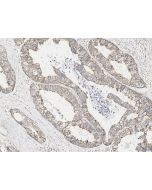
Recombinant Human GNG13 protein (Catalog#13173-H07E)
Preparation
Produced in rabbits immunized with purified, recombinant Human GNG13 (rh GNG13; Catalog#13173-H07E; Q9P2W3; Met1-Cys64). GNG13 specific IgG was purified by Human GNG13 affinity chromatography.
Source
Polyclonal Rabbit IgG
Purification
Protein A & Antigen Affinity
Formulation
0.2 μm filtered solution in PBS
Conjugate
Unconjugated
Form
Liquid
Shipping
This antibody is shipped as liquid solution at ambient temperature. Upon receipt, store it immediately at the temperature recommended below.
Storage
This antibody can be stored at 2℃-8℃ for one month without detectable loss of activity. Antibody products are stable for twelve months from date of receipt when stored at -20℃ to -80℃. Preservative-Free. Avoid repeated freeze-thaw cycles.
guanine nucleotide binding protein (G protein), gamma 13
Description
GNG13 is a subunit of heterotrimeric G proteins which consist of alpha, beta, and gamma subunits. Heterotrimeric G proteins are membrane-bound GTPases that are linked to 7-TM receptors. They function as signal transducers for the 7-transmembrane-helix G protein-coupled receptors. They are involved as a modulator or transducer in various transmembrane signaling systems. Each G protein is composed of an alpha-, beta- and gamma-subunit and is bound to GDP in the 'off' state. Ligand-receptor binding results in detachment of the G protein, switching it to an 'on' state and permitting Galpha activation of second messenger signaling cascades. There are several types of Galpha proteins; besides, some Gbetagamma subunits have active functions. Gbetagamma coupled to H1 receptors can activate PLA2 and Gbetagamma coupled to M1 receptors can activate KIR channels. The beta and gamma chains are required for the GTPase activity, for replacement of GDP by GTP, and G protein-effector interaction. GNG13 is a gamma subunit that is expressed in taste, retinal, and neuronal tissues and plays a key role in taste transduction.
References
Huang L, et al . (2000) Ggamma13 colocalizes with gustducin in taste receptor cells and mediates IP3 responses to bitter denatonium. Nat Neurosci. 2 (12): 1055-62.
Blake B L, et al . (2001) G beta association and effector interaction selectivities of the divergent G gamma subunit G gamma(13). J Biol Chem. 276 (52): 49267-74.
Bonaldo MF, et al . (1997) Normalization and subtraction: two approaches to facilitate gene discovery. Genome Res. 6 (9): 791-806.