Recombinant Anti-IL-13 R alpha 2/IL13RA2 Antibody (PE), Rabbit Monoclonal
Validated applications
FCM (FAQ Protocol)
Species reactivity
Reacts with: Human
Specificity
Human IL-13 R alpha 2/IL13RA2
Immunogen
Recombinant Human IL13RA2 / CD213A2 Protein (Catalog#10350-H08H)
Preparation
This antibody was obtained from a rabbit immunized with purified, recombinant Human IL13RA2 / CD213A2 (rh IL13RA2 / CD213A2; Catalog#10350-H08H; NP_000631.1; Met1-Leu342) and conjugated with PE under optimum conditions, the unreacted PE was removed.
Source
Monoclonal Rabbit IgG Clone #018
Purification
Protein A
Formulation
PBS solution containing 0.5% BSA and 0.09% sodium azide
Concentration
5 μl/Test, 0.1 mg/ml
Conjugate
PE
Form
Liquid
Shipping
This antibody is shipped as liquid solution at ambient temperature. Upon receipt, store it immediately at the temperature recommended below.
Storage
This antibody can be stored at 2℃-8℃ for twelve months without detectable loss of activity. Protected from prolonged exposure to light. Do not freeze ! Sodium azide is toxic to cells and should be disposed of properly. Flush with large volumes of water during disposal.
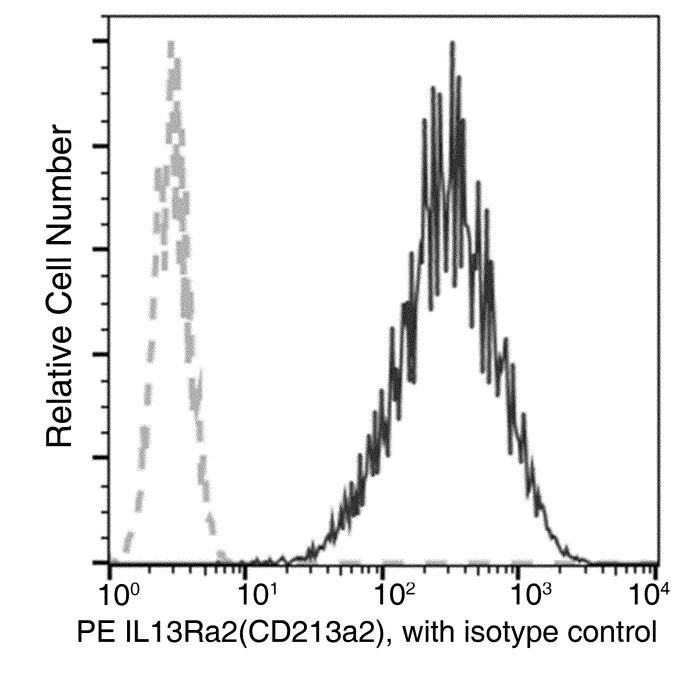
Flow cytometric analysis of Human IL13Ra2(CD213a2) expression on A375 cells. Cells were stained with PE-conjugated anti-Human IL13Ra2(CD213a2). The fluorescence histograms were derived from gated events with the forward and side light-scatter characteristics of intact cells.
Interleukin-13 receptor subunit alpha-2 (IL13RA2/IL-13RA2) is also known as cluster of differentiation 213A2 (CD213A2), IL-13 receptor subunit alpha-2, IL-13R subunit alpha-2, and IL-13RA2. The IL13RA2 is often overexpressed in brain tumors, making Il13ra2 one of the vaccine targets for immunotherapy of glioma. IL13RA2/IL-13RA2 is a cancer-associated receptor that is present in greater than 80% of High-Grade Astrocytomas (HGA) and has recently been recognized as a cytokine that predisposes breast cancer cells to metastasize. Expression of IL13Rα2 was rapidly lost from the surface of transduced cells grown in culture. The loss appeared to be related to ligands present in fetal bovine serum in the medium. None of the malignant glioma cell lines cultivated in vitro and tested to date exhibited the IL13Rα2 receptor. A recombinant virus (R5111) enters cells via its interaction with the IL13Rα2 receptor in a manner that cannot be differentiated from the interaction of wild-type virus with its receptors.
References
Zhou G, et al. . (2005) Characterization of a recombinant herpes simplex virus 1 designed to enter cells via the IL13Ralpha2 receptor of malignant glioma cells. J Virol. 79(9): 5272-7.
Osawa M, et al. . (2000) Characterization of the mouse interleukin-13 receptor alpha1 gene. Immunogenetics. 51(11): 974-81.
Nair BG, et al. . (2011) Nanotechnology platforms; an innovative approach to brain tumor therapy. Med Chem. 7(5): 488-503.
Benson M, et al. . (2006) A network-based analysis of the late-phase reaction of the skin. J Allergy Clin Immunol. 118(1): 220-5.

-R018-PE-A375.png)