Recombinant Human Insulin Receptor/INSR/CD220 Protein (Catalog#11086-H08H)
Preparation
This antibody was produced from a hybridoma resulting from the fusion of a mouse myeloma with B cells obtained from a mouse immunized with purified, recombinant Human Insulin Receptor/INSR/CD220 (rh Insulin Receptor/INSR/CD220; Catalog#11086-H08H; NP_001073285.1; Met1-Lys944). The IgG fraction of the cell culture supernatant was purified by Protein A affinity chromatography.
Source
Monoclonal Mouse IgG1 Clone #01
Purification
Protein A
Formulation
0.2 μm filtered solution in PBS
Conjugate
Unconjugated
Form
Liquid
Shipping
This antibody is shipped as liquid solution at ambient temperature. Upon receipt, store it immediately at the temperature recommended below.
Storage
This antibody can be stored at 2℃-8℃ for one month without detectable loss of activity. Antibody products are stable for twelve months from date of receipt when stored at -20℃ to -80℃. Preservative-Free. Avoid repeated freeze-thaw cycles.
Synonyms: Anti-CD220 Antibody; Anti-HHF5 Antibody
Image / Experimental Information
Image 1 Description
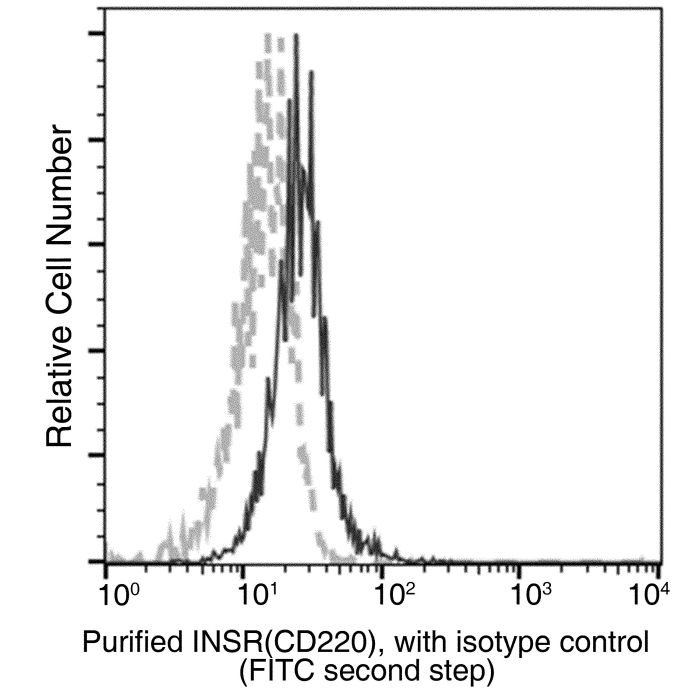
Flow cytometric analysis of Human INSR(CD220) expression on human whole blood monocytes. Cells were stained with purified anti-Human INSR(CD220), then a FITC-conjugated second step antibody. The fluorescence histograms were derived from gated events with the forward and side light-scatter characteristics of viable monocytes.
Image 1 Alt Text
Human Insulin Receptor/INSR/CD220 Flow Cytometry (FC) 18017
INSR (Insulin receptor), also known as CD220, is a transmembrane receptor that is activated by insulin. INSR belongs to the protein kinase superfamily and exists as a tetramer consisting of two alpha subunits and two beta subunits linked by disulfide bonds. The alpha and beta subunits are encoded by a single INSR gene, and the beta subunits pass through the cellular membrane. As the receptor for insulin with tyrosine-protein kinase activity, INSR associates with downstream mediators upon binding to insulin, including IRS1 (insulin receptor substrate 1) and phosphatidylinositol 3'-kinase (PI3K). IRS-1 binding and phosphorylation eventually lead to an increase in the high-affinity glucose transporter (Glut4) molecules on the outer membrane of insulin-responsive tissues. INSR isoform long and isoform short are expressed in the peripheral nerve, kidney, liver, striated muscle, fibroblasts and skin, and is found as a hybrid receptor with IGF1R which also binds IGF1 in muscle, heart, kidney, adipose tissue, skeletal muscle, hepatoma, fibroblasts, spleen, and placenta. Defects in Insulin Receptor/INSR are the cause of Rabson-Mendenhall syndrome (Mendenhall syndrome), insulin resistance (Ins resistance), leprechaunism (Donohue syndrome), and familial hyperinsulinemic hypoglycemia 5 (HHF5). It may also be associated with noninsulin-dependent diabetes mellitus (NIDDM).
Research Areas
Receptor Tyrosine Kinases (RTKs)
Related Pathways
AMPK Signaling Pathway
Autophagy Pathway
References
Ebina Y., et al. ,(1985), The human insulin receptor cDNA: the structural basis for hormone-activated transmembrane signalling. Cell 40:747-758.
Ullrich A., et al. , (1985), Human insulin receptor and its relationship to the tyrosine kinase family of oncogenes.Nature 313:756-761.
Grimwood J., et al. ,(2004), The DNA sequence and biology of human chromosome 19.Nature 428:529-535.

-MM01-Purified-Monocytes.png)