A synthetic peptide corresponding to the center region of the Human Junctional Adhesion Molecule B/JAM2
Preparation
Produced in rabbits immunized with a synthetic peptide corresponding to the center region of the Human Junctional Adhesion Molecule B/JAM2, and purified by antigen affinity chromatography.
Source
Polyclonal Rabbit IgG
Purification
Protein A & Antigen Affinity
Formulation
0.2 μm filtered solution in PBS
Conjugate
Unconjugated
Form
Liquid
Shipping
This antibody is shipped as liquid solution at ambient temperature. Upon receipt, store it immediately at the temperature recommended below.
Storage
This antibody can be stored at 2℃-8℃ for one month without detectable loss of activity. Antibody products are stable for twelve months from date of receipt when stored at -20℃ to -80℃. Preservative-Free. Avoid repeated freeze-thaw cycles.
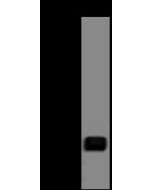
Anti-JAM2 rabbit polyclonal antibody at 1:500 dilution Lane A: A431 Whole Cell Lysate Lane B: Hela Whole Cell Lysate Lysates/proteins at 30 μg per lane. Secondary Goat Anti-Rabbit IgG (H+L)/HRP at 1/10000 dilution. Developed using the ECL technique. Performed under reducing conditions. Predicted band size:33 kDa Observed band size:43 kDa (We are unsure as to the identity of these extra bands.)
Anti-JAM2 rabbit polyclonal antibody at 1:500 dilution Lane A: A431 Whole Cell Lysate Lane B: Hela Whole Cell Lysate Lysates/proteins at 30 μg per lane. Secondary Goat Anti-Rabbit IgG (H+L)/HRP at 1/10000 dilution. Developed using the ECL technique. Performed under reducing conditions. Predicted band size:33 kDa Observed band size:43 kDa (We are unsure as to the identity of these extra bands.)
Junctional adhesion molecule B (JAM-B), also known as Junctional adhesion molecule 2 (JAM2), Vascular endothelial junction-associated molecule (VE-JAM), and CD322, is a single-pass type I membrane protein that belongs to the immunoglobulin superfamily. It is prominently expressed on high endothelial venules. expression to be restricted to the high endothelial venule of tonsil and lymph nodes. The localization to the endothelium of arterioles in and around inflammatory and tumor foci. JAM-B can function as an adhesive ligand for the T cell line J45 and can interact with GM-CSF/IL-4-derived peripheral blood dendritic cells, circulating CD56(+) NK cells, circulating CD56(+)CD3(+) NK/T cells, and circulating CD56(+)CD3(+)CD8(+) cytolytic T cells. JAM-2 is expressed on high endothelial venules (HEVs) in human tonsil and on a subset of human leukocytes, suggesting that JAM-2 plays a central role in the regulation of transendothelial migration. It binds to very late activation antigen (VLA)-4, a leucocyte integrin that contributes to rolling and firm adhesion of lymphocytes to endothelial cells through binding to vascular cell adhesion molecule (VCAM)-1. JAM-B appears to contribute to leukocyte extravasation by facilitating not only transmigration but also rolling and adhesion. JAM-B acts as an adhesive ligand for interacting with a variety of immune cell types and may play a role in lymphocyte homing to secondary lymphoid organs.
References
Johnson-Lger CA, et al. (2002) Junctional adhesion molecule-2 (JAM-2) promotes lymphocyte transendothelial migration. Blood. 2100(7): 2479-86.
Liang TW, et al. (2002) Vascular endothelial-junctional adhesion molecule (VE-JAM)/JAM 2 interacts with T, NK, and dendritic cells through JAM 3. J Immunol. 168(4): 1618-26.
Ludwig RJ, et al. (2009) Junctional adhesion molecule (JAM)-B supports lymphocyte rolling and adhesion through interaction with alpha4beta1 integrin. Immunology. 128(2): 196-205.



-HD10JL2108-WB.png)
