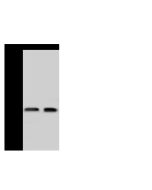
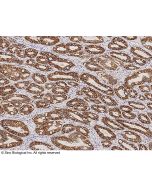
Human Kallikrein 1 No cross-reactivity in ELISA with Human KLK4 / Kallikrein 4 Human KLK7 / Kallikrein 7 Human KLK8 / Kallikrein 8 Human KLK11 / Kallikrein 11 Human KLK13 / Kallikrein 13 Human HGFA / HGF Activator Human FA11 Human Urokinase / PLAU / u-PA Human FX / Coagulation Factor X Human cell lysate (293 cell line)
Immunogen
Recombinant Human KLK1 / Kallikrein 1 Protein (Catalog#10407-H08H)
Preparation
This antibody was produced from a hybridoma resulting from the fusion of a mouse myeloma with B cells obtained from a mouse immunized with purified, recombinant Human KLK1 / Kallikrein 1 (rh KLK1 / Kallikrein 1; Catalog#10407-H08H; NP_002248.1; Met 1-Ser 262). The IgG fraction of the cell culture supernatant was purified by Protein A affinity chromatography.
Source
Monoclonal Mouse IgG1 Clone #7B5B3
Purification
Protein A
Formulation
0.2 μm filtered solution in PBS
Conjugate
Unconjugated
Form
Liquid
Shipping
This antibody is shipped as liquid solution at ambient temperature. Upon receipt, store it immediately at the temperature recommended below.
Storage
This antibody can be stored at 2℃-8℃ for one month without detectable loss of activity. Antibody products are stable for twelve months from date of receipt when stored at -20℃ to -80℃. Preservative-Free. Avoid repeated freeze-thaw cycles.
KLK1 (Kallikrein 1) is a Protein Coding gene. This gene is one of the fifteen kallikrein subfamily members located in a cluster on chromosome 19. This protein is functionally conserved in its capacity to release the vasoactive peptide, Lys-bradykinin, from low molecular weight kininogen. Human tissue kallikrein (KLK1) is a serine protease, a component of the KKS that has been demonstrated to exert pleiotropic beneficial effects in protection from tissue injury through its anti-inflammatory, antiapoptotic, antifibrotic, and antioxidative actions. Polymorphism of the human tissue kallikrein 1 (KLK1) A1789G gene is associated with susceptibility to hypertension. Diseases associated with KLK1 include Kallikrein, Decreased Urinary Activity Of and Hereditary Angioedema.