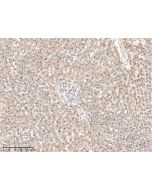
WB (FAQ Protocol), ELISA (FAQ Protocol), IP (FAQ Protocol)
Species reactivity
Reacts with: Human
Specificity
Human LC3B
Immunogen
Recombinant Human LC3B / MAP1LC3B protein (Catalog#14555-H07E)
Preparation
Produced in rabbits immunized with purified, recombinant Human LC3B / MAP1LC3B (rh LC3B / MAP1LC3B; Catalog#14555-H07E; Q9GZQ8; Met1-Val125). LC3B / MAP1LC3B specific IgG was purified by Human LC3B / MAP1LC3B affinity chromatography.
Source
Polyclonal Rabbit IgG
Purification
Protein A & Antigen Affinity
Formulation
0.2 μm filtered solution in PBS
Conjugate
Unconjugated
Form
Liquid
Shipping
This antibody is shipped as liquid solution at ambient temperature. Upon receipt, store it immediately at the temperature recommended below.
Storage
This antibody can be stored at 2℃-8℃ for one month without detectable loss of activity. Antibody products are stable for twelve months from date of receipt when stored at -20℃ to -80℃. Preservative-Free. Avoid repeated freeze-thaw cycles.
Anti-MAP1LC3B rabbit polyclonal antibody at 1:500 dilution Lane A: Mouse brain Tissue Lysate Lane B: Rat brain Tissue Lysate Lysates/proteins at 30 μg per lane. Secondary Goat Anti-Rabbit IgG H&L (Dylight800) at 1/10000 dilution. Developed using the Odyssey technique. Performed under reducing conditions. Predicted band size:15 kDa Observed band size:16 kDa
Anti-MAP1LC3B rabbit polyclonal antibody at 1:500 dilution Lane A: Mouse brain Tissue Lysate Lane B: Rat brain Tissue Lysate Lysates/proteins at 30 μg per lane. Secondary Goat Anti-Rabbit IgG H&L (Dylight800) at 1/10000 dilution. Developed using the Odyssey technique. Performed under reducing conditions. Predicted band size:15 kDa Observed band size:16 kDa
Image 2 Alt Text
Human LC3B / MAP1LC3B Immunoprecipitation(IP) 15290
microtubule-associated protein 1 light chain 3 beta
Description
MAP1LC3B (Microtubule Associated Protein 1 Light Chain 3 beta, also known as LC3B) is a Protein Coding gene. The product of this gene is a subunit of neuronal microtubule-associated MAP1A and MAP1B proteins, which are involved in microtubule assembly and important for neurogenesis. LC3B is a member of the MAP1 LC3 family. It is most abundantly expressed in the heart, brain, skeletal muscle, and testis. LC3B is a subunit of the neuronal microtubule and functions in the formation of autophagosomal vacuoles (autophagosomes). It is associated with MAP1A and MAP1B proteins, which are involved in microtubule assembly and important for neurogenesis. LC3B also plays a role in autophagy, a process that involves the bulk degradation of the cytoplasmic component.
Related Pathways
Autophagy Pathway
References
Behrends C. et al., 2010, Nature. 466 (7302): 68-76.
Tanida I. et al., 2005, Int J Biochem Cell Biol. 36 (12): 2503-18.