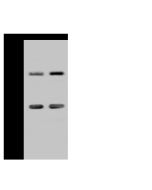
Recombinant Human CD19 protein (Catalog#11880-H08H)
Preparation
This antibody was obtained from a rabbit immunized with purified, recombinant Human CD19 (rh CD19; Catalog#11880-H08H; P15391-1; Met1-Lys291).
Source
Monoclonal Rabbit IgG Clone #109
Purification
Protein A
Formulation
0.2 μm filtered solution in PBS
Conjugate
Unconjugated
Form
Liquid
Shipping
This antibody is shipped as liquid solution at ambient temperature. Upon receipt, store it immediately at the temperature recommended below.
Storage
This antibody can be stored at 2℃-8℃ for one month without detectable loss of activity. Antibody products are stable for twelve months from date of receipt when stored at -20℃ to -80℃. Preservative-Free. Avoid repeated freeze-thaw cycles.
Synonyms: Anti-B4 Antibody; Anti-CVID3 Antibody
Image / Experimental Information
Image 1 Description
Immunochemical staining CD19 in human tonsil with rabbit monoclonal antibody (1:300, formalin-fixed paraffin embedded sections). Positive staining was localized to membrane of B cells.
Image 1 Alt Text
Human CD19/B4/CVID3 Immunohistochemistry(IHC) 4550
Immunochemical staining CD19 in human tonsil with rabbit monoclonal antibody (1:300, formalin-fixed paraffin embedded sections). Positive staining was localized to membrane of B cells.
Image 2 Alt Text
Human CD19/B4/CVID3 Immunohistochemistry(IHC) 4551
Immunochemical staining CD19 in human tonsil with rabbit monoclonal antibody (1:300, formalin-fixed paraffin embedded sections). Positive staining was localized to membrane of B cells.
The cluster of differentiation (CD) system is commonly used as cell markers in Immunophenotyping. Different kinds of cells in the immune system can be identified through the surface CD molecules associating with the immune function of the cell. There are more than 320 CD unique clusters and subclusters have been identified. Some of the CD molecules serve as receptors or ligands important to the cell through initiating a signal cascade which then alter the behavior of the cell. Some CD proteins do not take part in cell signal process but have other functions such as cell adhesion. Cluster of differentiation 19 (CD19) is a member of CD system. CD19 is a cell surface molecule that assembles with the antigen receptor of B-cells. This results in a descent in the threshold for antigen receptor-dependent stimulation. A simplified view holds that the ability of B-cells to respond to the various antigens in a specific and sensitive manner is achieved in the presence of low-affinity antigen receptors. CD19 primarily acts as a B-cell co-receptor in conjunction with CD21 and CD81. The formation of the receptor complex is induced by antigen and CD19, induced by exogenous antigen, has been found cytoplasmic tail phosphorylated and bind to sIg.
Research Areas
Cancer Drug Targets
Related Pathways
B Cell Receptor Signaling Pathway
Tags
Cancer Immunotherapy
Immune Checkpoint
Immunotherapy
Targeted Therapy
References
Zola H, et al. (2007) CD molecules 2006-human cell differentiation molecules. J Immunol Methods. 318 (1-2): 1-5.
Ho IC, et al. (2009) GATA3 and the T-cell lineage: essential functions before and after T-helper-2-cell differentiation. Nat Rev Immunol. 9 (2): 125-35.
Matesanz-Isabel J, et al. (2011) New B-cell CD molecules. Immunology Letters.134 (2): 104-12.
Carter RH, et al. (1992) CD19: lowering the threshold for antigen receptor stimulation of B lymphocytes. Science. 256 (5053): 105-7.