Anti-Cytokeratin 14/KRT14 Antibody, Rabbit Polyclonal sinobiological 100129-RP02
| Catalog No. | Size | Price (USD) |
| 100129-RP02-50 | 50 µL | $147.96 |
| 100129-RP02-100 | 100 µL | $251.64 |
| 100129-RP02-200 | 200 µL | $355.32 |
| Catalog No. | Size | Price (USD) |
| 100129-RP02-50 | 50 µL | $147.96 |
| 100129-RP02-100 | 100 µL | $251.64 |
| 100129-RP02-200 | 200 µL | $355.32 |
General Information
| Product name | Anti-Cytokeratin 14/KRT14 Antibody, Rabbit Polyclonal |
| Validated applications | WB (FAQ Protocol), IHC-P (FAQ Protocol) |
| Species reactivity | Reacts with: Human, Mouse, Rat |
| Specificity | Human Mouse, Rat (Species predicted to react based on 100% sequence homology) |
| Immunogen | A synthetic peptide corresponding to the C-terminus of the human Cytokeratin 14. |
| Preparation | Produced in rabbits immunized with purified, a synthetic peptide corresponding to the C-terminus of the human Cytokeratin 14, and purified by antigen affinity chromatography. |
| Source | Polyclonal Rabbit IgG |
| Purification | Protein A & Antigen Affinity |
| Formulation | 0.2 μm filtered solution in PBS |
| Conjugate | Unconjugated |
| Form | Liquid |
| Shipping | This antibody is shipped as liquid solution at ambient temperature. Upon receipt, store it immediately at the temperature recommended below. |
| Storage | This antibody can be stored at 2℃-8℃ for one month without detectable loss of activity. Antibody products are stable for twelve months from date of receipt when stored at -20℃ to -80℃. Preservative-Free. Avoid repeated freeze-thaw cycles. |
Synonyms: Anti-CK14 Antibody; Anti-EBS1 Antibody; Anti-EBS1A Antibody; Anti-EBS1B Antibody; Anti-EBS1C Antibody; Anti-EBS1D Antibody; Anti-EBS3 Antibody; Anti-EBS4 Antibody; Anti-K14 Antibody; Anti-NFJ Antibody
Image / Experimental Information
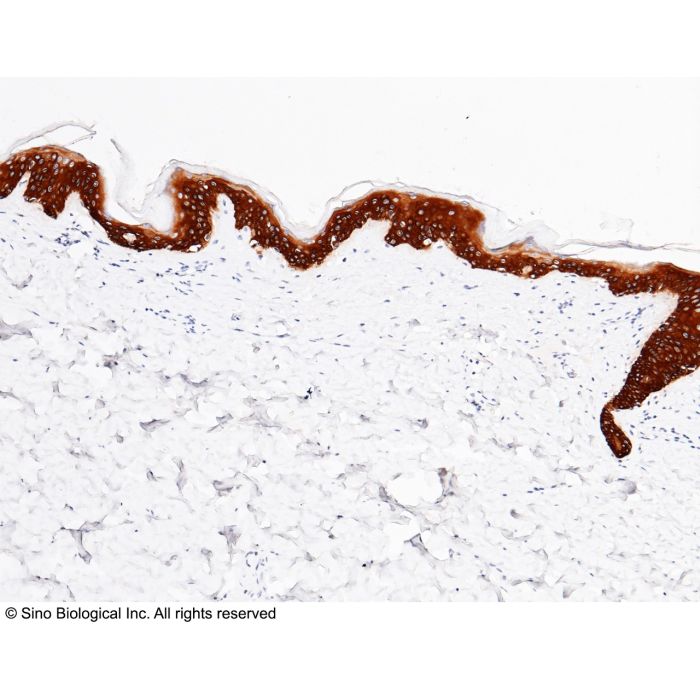
| Image 1 Description | Immunochemical staining CK14 in human skin with rabbit polyclonal antibody (1:1000, formalin-fixed paraffin embedded sections). |
| Image 1 Alt Text | Human KRT14 Immunohistochemistry(IHC) 4410 |
| Image 1 URL | Source image |
| Image 2 Description | Immunochemical staining CK14 in human skin with rabbit polyclonal antibody (1:1000, formalin-fixed paraffin embedded sections). |
| Image 2 Alt Text | Human KRT14 Immunohistochemistry(IHC) 4412 |
| Image 2 URL | Source image |
| Image 3 Description | Immunochemical staining CK14 in human skin with rabbit polyclonal antibody (1:1000, formalin-fixed paraffin embedded sections). |
| Image 3 Alt Text | Human KRT14 Western blot (WB) 13049 |
| Image 3 URL | Source image |
| Image 4 Description | Immunochemical staining CK14 in human skin with rabbit polyclonal antibody (1:1000, formalin-fixed paraffin embedded sections). |
| Image 4 Alt Text | Human KRT14 Immunohistochemistry(IHC) 15053 |
| Image 4 URL | Source image |
| Image 5 Description | Immunochemical staining CK14 in human skin with rabbit polyclonal antibody (1:1000, formalin-fixed paraffin embedded sections). |
| Image 5 Alt Text | Human KRT14 Immunohistochemistry(IHC) 15054 |
| Image 5 URL | Source image |
Background Information
| Full Name | keratin 14, type I |
| Description | Cytokeratin 14, also known as Keratin 14 and K14, is a member of the keratin family. Cytokeratin 14 is a type I keratin. It is usually found as a heterotetramer with two keratin 5 molecules, a type II keratin. Together they form the cytoskeleton of epithelial cells. Cytokeratin 14 is mainly expressed in the basal layer. It is also strongly expressed in the outer root sheath of anagen follicles. Cytokeratin 14 and keratin 5 may have a role in the maintenance of cell proliferation potential in the basal layer of stratified epithelia, modulating phosphatidylinositol 3-kinase/Akt–mediated cell proliferation and/or Notch1-dependent cell differentiation. Cytokeratin 14 defect prevents it from working effectively with keratin 5 and interfering with the assembly of the keratin intermediate filament network. A disruption in this network makes keratinocytes fragile and prone to rupture. Minor trauma to the skin, such as rubbing or scratching, can cause these cells to break down, resulting in the formation of painful, fluid-filled blisters. Mutations in the K14 gene are also responsible for Naegeli-Franceschetti-Jadassohn syndrome and Dermatopathia Pigmentosa Reticularis. |
| References |
|
title: Dll1 + quiescent tumor stem cells drive chemoresistance in breast cancer through NF-κB survival pathway
authors: Sushil Kumar; Ajeya Nandi; ...; Rumela Chakrabarti
journal: Nature Communications
date: 2021-01-18
pmid: 33462238
doi: 10.1038/s41467-020-20664-5
pmcid: 7813834
cited_by_count: 37
techniques: Flow Cytometry; Immunohistochemistry; In Situ; MTT Assay; Quantitative RT-PCR; Radial Immuno Diffusion; Recombinant; TUNEL Assay; Western Blot
bioz_score: 90