Produced in rabbits immunized with E. coli-derived Human CAMLG fragment, and purified by antigen affinity chromatography.
Source
Polyclonal Rabbit IgG
Purification
Protein A & Antigen Affinity
Formulation
PBS, pH7.0 with 0.03% Proclin300
Conjugate
Unconjugated
Form
Liquid
Shipping
This antibody is shipped as liquid solution at ambient temperature. Upon receipt, store it immediately at the temperature recommended below.
Storage
This antibody can be stored at 2℃-8℃ for one month without detectable loss of activity. Antibody products are stable for twelve months from date of receipt when stored at -20℃ to -80℃. Avoid repeated freeze-thaw cycles.
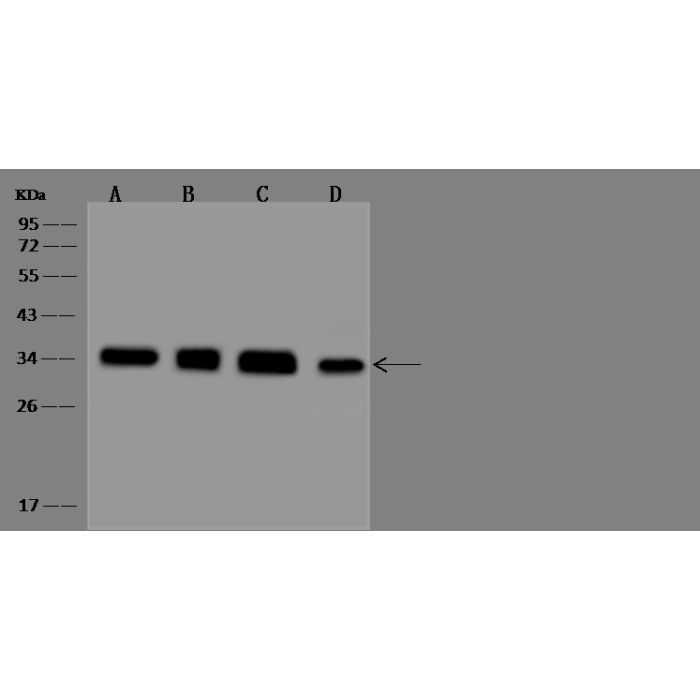
Anti-CAMLG rabbit polyclonal antibody at 1:500 dilution Lane A: Jurkat Whole Cell Lysate Lane B: U-87 MG Whole Cell Lysate Lane C: SH-SY5Y Whole Cell Lysate Lane D: U-251MG Whole Cell Lysate Lysates/proteins at 30 μg per lane. Secondary Goat Anti-Rabbit IgG (H+L)/HRP at 1/10000 dilution. Developed using the ECL technique. Performed under reducing conditions. Predicted band size:33 kDa Observed band size:34 kDa
Anti-CAMLG rabbit polyclonal antibody at 1:500 dilution Lane A: Jurkat Whole Cell Lysate Lane B: U-87 MG Whole Cell Lysate Lane C: SH-SY5Y Whole Cell Lysate Lane D: U-251MG Whole Cell Lysate Lysates/proteins at 30 μg per lane. Secondary Goat Anti-Rabbit IgG (H+L)/HRP at 1/10000 dilution. Developed using the ECL technique. Performed under reducing conditions. Predicted band size:33 kDa Observed band size:34 kDa
The CAMLG gene encodes a novel cyclophilin B-binding protein called calcium-modulating cyclophilin ligand, which appears to be involved in the regulation of calcium signaling in T lymphocytes and other cells. CAMLG is the major host cell PilA binding protein. The murine homolog, Caml, was localized by interspecific backcross analysis to the middle of chromosome 13. By fluorescence in situ hybridization, this gene was localized to human chromosome 5 in a region (q23) known to be syntenic to mouse chromosome 13. Expression of human CAML (encoded by CAMLG) in AGM cells conferred a strong restriction of virus release that was reversed by Vpu and HIV-2 Env, suggesting that CAML is the mechanistic link between these two viral regulators. Depletion of CAML in human cells eliminated the need for Vpu in enhancing HIV-1 and murine leukemia virus release.
References
Okuda J, et al. (2013) Type iv pilus protein pila of pseudomonas aeruginosa modulates calcium signaling through binding the calcium-modulating cyclophilin ligand. J Infect Chemother 19 (4): 653-664.
Bram RJ, et al. (1996) The gene for calcium-modulating cyclophilin ligand (camlg) is located on human chromosome 5q23 and a syntenic region of mouse chromosome 13. Genomics 31 (2): 257-260.
(2010) Retraction: Identification of calcium-modulating cyclophilin ligand as a human host restriction to hiv-1 release overcome by vpu. Nat Med 16 (2): 238.


-HD12OC0636-WB.png)
-HD12OC0636-100-human-brain-IHC-P.png)