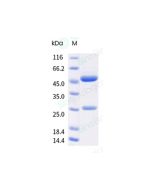
Recombinant Canine HGF/Hepatocyte Growth Factor Protein (Catalog#70063-DNAH)
Preparation
This antibody was obtained from a rabbit immunized with purified, recombinant Canine HGF/Hepatocyte Growth Factor (Catalog#70063-DNAH; NP_001002964.1; Met1-Ser730).
Source
Monoclonal Rabbit IgG Clone #105
Purification
Protein A
Formulation
0.2 μm filtered solution in PBS
Conjugate
Unconjugated
Form
Liquid
Shipping
This antibody is shipped as liquid solution at ambient temperature. Upon receipt, store it immediately at the temperature recommended below.
Storage
This antibody can be stored at 2℃-8℃ for one month without detectable loss of activity. Antibody products are stable for twelve months from date of receipt when stored at -20℃ to -80℃. Preservative-Free. Avoid repeated freeze-thaw cycles.
Hepatocyte growth factor, also known as HGF, contains 4 kringle domains, 1 PAN domain, and 1 peptidase S1 domain. It belongs to the peptidase S1 family, plasminogen subfamily. The hepatocyte growth factor is secreted by mesenchymal cells as a single inactive polypeptide and is cleaved by serine proteases into a 69-kDa alpha-chain and 34-kDa beta-chain. A disulfide bond between the alpha and beta chains produces the active, heterodimeric molecule. The hepatocyte growth factor regulates cell growth, cell motility, and morphogenesis by activating a tyrosine kinase signaling cascade after binding to the proto-oncogenic c-Met receptor, and acts as a multi-functional cytokine on cells of mainly epithelial origin. Its ability to stimulate mitogenesis, cell motility and matrix invasion give it a central role in angiogenesis, tumorogenesis, and tissue regeneration. HGF is a potent mitogen for mature parenchymal hepatocyte cells, seems to be an hepatotrophic factor, and acts as a growth factor for a broad spectrum of tissues and cell types. HGF has no detectable protease activity. Defects in hepatocyte growth factor are the cause of deafness autosomal recessive type 39. A form of profound prelingual sensorineural hearing loss. Sensorineural deafness results from damage to the neural receptors of the inner ear, the nerve pathways to the brain, or the area of the brain that receives sound information.
Research Areas
Cancer Drug Targets
Tags
Cancer Immunotherapy
Immune Checkpoint
Immunotherapy
Targeted Therapy
References
Naldini L, et al. (1991) Scatter factor and hepatocyte growth factor are indistinguishable ligands for the MET receptor. EMBO J. 10(10):2867-78.
Comoglio, et al. (1993) Structure, biosynthesis and biochemical properties of the HGF receptor in normal and malignant cells. 65:131-65.
Hahn W, et al. (2011) Enhanced cardioprotective effects by coexpression of two isoforms of hepatocyte growth factor from naked plasmid DNA in a rat ischemic heart disease model. The Journal of Gene Medicine. 13(10):549-55.
Bottaro DP, et al. (1991) Identification of the hepatocyte growth factor receptor as the c-met proto-oncogene product. Science. 251(4995):802-4.