WB (FAQ Protocol), IHC-P (FAQ Protocol), IP (FAQ Protocol)
Species reactivity
Reacts with: Mouse
Specificity
Mouse Carbonic Anhydrase IV/CA4
Immunogen
Recombinant Mouse Car4 Protein (Catalog#50350-M08H)
Preparation
Produced in rabbits immunized with purified, recombinant Mouse Car4 (rM Car4; Catalog#50350-M08H; NP_031633.1; Met1-Ser277). Car4 specific IgG was purified by Mouse Car4 affinity chromatography.
Source
Polyclonal Rabbit IgG
Purification
Protein A & Antigen Affinity
Formulation
0.2 μm filtered solution in PBS
Conjugate
Unconjugated
Form
Liquid
Shipping
This antibody is shipped as liquid solution at ambient temperature. Upon receipt, store it immediately at the temperature recommended below.
Storage
This antibody can be stored at 2℃-8℃ for one month without detectable loss of activity. Antibody products are stable for twelve months from date of receipt when stored at -20℃ to -80℃. Preservative-Free. Avoid repeated freeze-thaw cycles.
Synonyms: Anti-Ca4 Antibody; Anti-Car4 Antibody
Image / Experimental Information
Image 1 Description
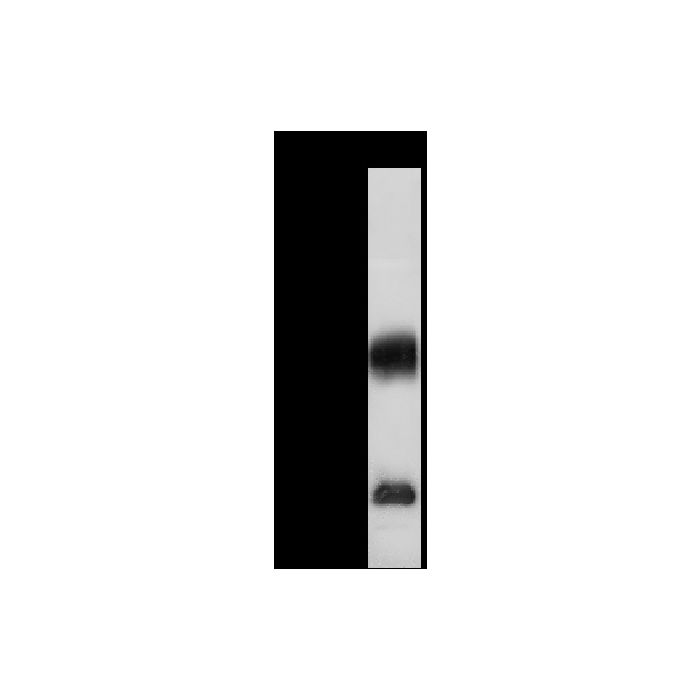
Anti-Carbonic Anhydrase IV rabbit polyclonal antibody at 1:500 dilution Lane A: Mouse lung tissue lysate Lysates/proteins at 30 μg per lane. Secondary Goat Anti-Rabbit IgG (H+L)/HRP at 1/10000 dilution. Developed using the ECL technique. Performed under reducing conditions. Predicted band size:35 kDa Observed band size:37 kDa (We are unsure as to the identity of these extra bands.)
Image 1 Alt Text
Mouse Carbonic Anhydrase IV Western blot (WB) 32123
Anti-Carbonic Anhydrase IV rabbit polyclonal antibody at 1:500 dilution Lane A: Mouse lung tissue lysate Lysates/proteins at 30 μg per lane. Secondary Goat Anti-Rabbit IgG (H+L)/HRP at 1/10000 dilution. Developed using the ECL technique. Performed under reducing conditions. Predicted band size:35 kDa Observed band size:37 kDa (We are unsure as to the identity of these extra bands.)
Image 2 Alt Text
Mouse Carbonic Anhydrase IV Immunohistochemistry(IHC) 32124
Anti-Carbonic Anhydrase IV rabbit polyclonal antibody at 1:500 dilution Lane A: Mouse lung tissue lysate Lysates/proteins at 30 μg per lane. Secondary Goat Anti-Rabbit IgG (H+L)/HRP at 1/10000 dilution. Developed using the ECL technique. Performed under reducing conditions. Predicted band size:35 kDa Observed band size:37 kDa (We are unsure as to the identity of these extra bands.)
Image 3 Alt Text
Mouse Carbonic Anhydrase IV Immunohistochemistry(IHC) 32125
Anti-Carbonic Anhydrase IV rabbit polyclonal antibody at 1:500 dilution Lane A: Mouse lung tissue lysate Lysates/proteins at 30 μg per lane. Secondary Goat Anti-Rabbit IgG (H+L)/HRP at 1/10000 dilution. Developed using the ECL technique. Performed under reducing conditions. Predicted band size:35 kDa Observed band size:37 kDa (We are unsure as to the identity of these extra bands.)
Image 4 Alt Text
Mouse Carbonic Anhydrase IV Immunoprecipitation(IP) 32126
The carbonic anhydrases (or carbonate dehydratases) are classified as metalloenzyme for its zinc ion prosthetic group and form a family of enzymes that catalyze the rapid interconversion of carbon dioxide and water to bicarbonate and protons, a reversible reaction that takes part in maintaining acid-base balance in blood and other tissues. The carbonic anhydrasekl (CA) family consists of at least 11 enzymatically active members and a few inactive homologous proteins. Carbonic anhydrase IV (CAIV) is a membrane-associated enzyme anchored to plasma membrane surfaces by a phosphatidylinositol glycan linkage. CAIV is a high-activity isozyme in CO hydration comparable to that of CAII. Furthermore, CAIV is more active in HCO3 dehydration than is CAII. However, the esterase activity of CAIV is decreased 150-fold compared to CAII.
References
Lehtonen J, et al. (2004) Characterization of CA XIII, a Novel Member of the Carbonic Anhydrase Isozyme Family. The Journal of Biological Chemistry. 279: 2719-27.
Lindskog S. (1997) Structure and mechanism of carbonic anhydrase. Pharmacology & Therapeutics. 74(1):1-20.
Baird TT, et al. (1997) Catalysis and Inhibition of Human Carbonic Anhydrase IV. Biochemistry. 36 (9): 2669-78.



-HD15AP2117-2000-mouse-kidney-IHC-P.png)
-HD15AP2117-2000-mouse-lung-IHC-P.png)
