Recombinant Mouse Cathepsin L/CTSL Protein (Catalog#50015-M08H)
Preparation
Produced in rabbits immunized with purified, recombinant Mouse Cathepsin L/CTSL (rM Cathepsin L/CTSL; Catalog#50015-M08H; P06797; Met1-Asn334). Cathepsin L/CTSL specific IgG was purified by Mouse Cathepsin L/CTSL affinity chromatography.
Source
Polyclonal Rabbit IgG
Purification
Protein A & Antigen Affinity
Formulation
0.2 μm filtered solution in PBS
Conjugate
Unconjugated
Form
Liquid
Shipping
This antibody is shipped as liquid solution at ambient temperature. Upon receipt, store it immediately at the temperature recommended below.
Storage
This antibody can be stored at 2℃-8℃ for one month without detectable loss of activity. Antibody products are stable for twelve months from date of receipt when stored at -20℃ to -80℃. Preservative-Free. Avoid repeated freeze-thaw cycles.
Cathepsin L is a lysosomal cysteine protease that plays a major role in intracellular protein catabolism, and is potent in degrading collagen, laminin, elastin, as well as alpha-1 protease inhibitor and other structural proteins of basement membranes. It is secreted by liver flukes at all stages of their development in the mammalian host, are believed to play important roles in facilitating parasite migration (tissue degradation), feeding and immuno-evasion. Like many proteases, Cathepsin L is synthesized as an inactive preproenzyme, and cleavage of the 96-residue proregion is necessary to generate the fully active 221-residue mature enzyme. Studies have demonstrated that cleavage of the proregion occur autocatalytically under acidic conditions. The enzyme takes part in nutrient acquisition by catabolizing host proteins to absorbable peptides, facilitates the migration of the parasite through the host intestine and liver by cleaving interstitial matrix proteins such as fibronectin, laminin and native collagen and is implicated in the inactivation of host immune defenses by cleaving immunoglobulins. Recently, Cathepsin L has been shown to suppress Th1 immune response in infected laboratory animals making them susceptible to concurrent bacterial infections. Cathepsin L is synthesized in large amounts and secreted by many malignantly transformed cells, and induced by growth factors and tumor promoters. In addition to its role in protein degradation, evidence has accumulated for the participation of Cathepsin L in various physiological and pathological processes, such as tumor invasion and metastasis, bone resorption, spermatogenesis, and arthritis. Accordingly, Cathepsin L may prove useful as a diagnostic or prognostic marker of human tumor malignancy.
References
Mulcahy G, et al. (2001) Cathepsin L proteinases as vaccines against infection with Fasciola hepatica (liver fluke) in ruminants. Res Vet Sci. 70(1): 83-6.
Dixit AK, et al. (2008) Immunodiagnostic/protective role of cathepsin L cysteine proteinases secreted by Fasciola species. Vet Parasitol. 154(3-4): 177-84.
Leto G, et al. (2010) Cathepsin L in metastatic bone disease: therapeutic implications. Biol Chem. 391(6): 655-64.
title: A second functional furin site in the SARS-CoV-2 spike protein authors: Yue Zhang; Li Zhang; ...; Youchun Wang journal: Emerging microbes & infections date: 2022-01-04 pmid: 34856891 doi: 10.1080/22221751.2021.2014284 pmcid: 8741242 cited_by_count: 35 techniques: Generated; Recombinant bioz_score: 93
title: Cathepsin L expression in the carotid arteries of atherosclerotic swine authors: Ayisha Zaka Bashir; Khalid Bashir; ...; Devendra K. Agrawal journal: Archives of Medical Sciences. Atherosclerotic Diseases date: 2019-12-02 pmid: 32373754 doi: 10.5114/amsad.2019.90153 pmcid: 7197027 cited_by_count: 2 techniques: Immunofluorescence; Immunohistochemistry; Incubation; Staining bioz_score: 93

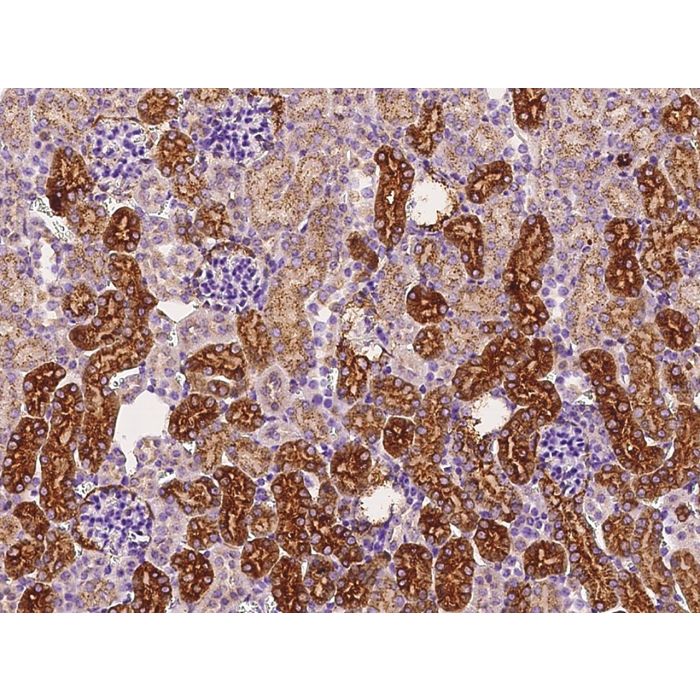
-HD12AP1619-1000-mouse-kidney-IHC-P.png)
-HD12AP1619-1000-mouse-liver-IHC-P.png)